Showing posts with label Resources. Show all posts

Wednesday, July 18, 2012

Shakespeare Study Guides – (Cummings)

For everyone who is interested in excellent Shakespeare guides and materials I really recommend Cummings Study Guides. We have recommended these materials in the past and are pleased to pass along that there have been many major updates and expansions to the original materials.

In their own words……

Plays, Sonnets, Poems

Play Summaries and Analysis: Plot summaries of all the plays, including those of doubtful or joint authorship, such as Edward III, The Two Noble Kinsmen, Sir Thomas More (partly written by Shakespeare), and Cardenio (probably partly written by Shakespeare). Criticism, sources, settings, dates, themes, and other information. 
Sonnet Summaries and Analysis: Definition, origin, and development of the sonnet form. Comparison of the Shakespearean sonnet with the Petrarchan sonnet. Analysis of the rhyme scheme of the Shakespearean sonnet. Common sonnet themes. Discussion of the "young man," "the dark lady," and the "rival poet" referred to in the sonnets. Sonnets and sexuality. 
Narrative and Complaint Poems: Background information, themes, style, and summaries of Shakespeare's long narrative poems—Venus and Adonis and The Rape of Lucrece—and the complaint poem, A Lover's Complaint (with an annotated text). Analysis of The Phoenix and the Turtle.

This is a

A Free Resource Posted by Michael J. Cummings (mcum.mings@mail.com)
Recommended as a Shakespeare Resource by The New York Times

Monday, February 21, 2011

APPLIED COMMUNICATION: Influence of Social Media

Popularity vs. Influence in Blogging and Social Media: What’s the Difference?

By Jennifer Mattern on April 13, 2010

influence

Credit: Advanced Human Technologies (www.ahtgroup.com)

You’ve heard about “influencers” right? That’s a big buzz word especially in the blogosphere these days (and it has been for a couple of years). What exactly is an influential blogger though? Do those lists of the most influential blogs or biggest influencers really mean much?

Honestly, they don’t. Why? Because sadly too many people confuse “influence” with basic popularity. Is there anything wrong with having a popular blog or being a popular personality in your niche or industry? No. Of course not. But being popular doesn’t mean you necessarily have a comparable amount of influence within that niche. Let’s explore both popularity and influence, and talk about why you really need to understand the difference. While we’ll look specifically at bloggers, the same can be true of those on Twitter, social networks, or who are active in any other area of social media.

Defining Popularity and Influence

What does it mean to be a “popular” blogger? It means that people like you (or they like your blog). Specifically related to blogging, it generally means a lot of people like you. You get a lot of traffic and / or a lot of unique visitors. You get a lot of comments. You get the idea….

If you have a lot of traffic, you naturally have a lot of influence, right? Wrong. Influence involves more than numbers. It involves your ability to influence outcomes, actions, and opinions.

The Biggest Difference Between Popularity and Influence

Being treated like a rockstar doesn't always equal influence

Being treated like a rock star doesn't always equal influence - Credit: BigStockPhoto.com

Let’s look at two hypothetical blogs to show why popularity doesn’t necessarily equate to influence. They’re both Internet marketing blogs. Blog A is a relatively high traffic blog — let’s say just under one million page views per month. Blog B gets around 75,000 page views per month instead (still not terrible, but clearly Blog A has them beat).

You could easily argue that Blog A is the more popular blog of the two. Assuming in this case that the larger number of page views comes from a larger number of unique visitors, Blog A has more readers / visitors.

That said, Blog B could still be the more influential blog. Numbers alone don’t cut it. The relationship between the blogger and their audience determines influence much more than traffic stats (or follower stats, or friend counts, etc.).

For example, maybe most of Blog A’s traffic comes from search engines. The visitors are one-time passers-by who only visit the page they land on. They read the content and then they move on. Blog B’s fewer readers are much more invested in the blog. They read regularly. They genuinely care about what the blogger has to say.

If Blogger A told their audience to do something, they might have less influence over their actual actions than Blogger B. The second blogger’s audience might be more likely to do what’s asked of them — think a certain way about a niche issue, try a new tool, take part in a survey, or even buy a product. That’s influence.

Popularity in blogging can leave a lot to chance (or basic search engine optimization). A blogger has to be able to take things a step further if they want to turn that popularity into influence. By all means, a popular blog can be influential. Many are. The mistake is in thinking that one necessarily equals or leads to the other.

Measuring Influence: Can it be Done?

Why do people often rank blogs by “influence” when they’re really only evaluating popularity metrics? Well, “influence” sounds better for starters. Who doesn’t want to feel like they have influence? It’s a power thing, whereas popularity is nice but it’s something tweens and teens are supposed to worry about — not professionals blogging within a given industry.

How do you measure success in social media?

How do you measure success in social media? - Credit: BigStockPhoto.com

Influence sounds better, but popularity is easier to measure. So they get packaged together whether or not it’s completely fair, “right,” or accurate. Is it even possible to measure influence? Personally, I consider it more of a qualitative than quantitative element of blogging and social media, and as such I would have to say it’s difficult, if not impossible, to accurately measure.

A blogger with a relatively small audience might have major pull in the industry because of their network. If they report a problem to a company, it might be fixed in hours or days instead of buried in a mountain of support tickets. If they request a new feature from someone, they might actually get it whereas others would be ignored. They might be able to change the minds of their audience members about an issue that’s important to them. I don’t see how those things can be accurately or fairly measured. Would action #1 get more weight than action #2? How many minds do you have to change to be “influential?”

Sure, we can measure some elements of influence — how many readers were converted into customers, the number of survey respondents, donations received when a blogger gets behind a cause, etc. But we can’t measure enough of the factors that determine influence to really say Blogger A is more influential than Blogger B, because the results of influence aren’t always visible. To outsiders, it’s all subjective.

If you really must rank the most “influential” blogs in some way, do what you must. But why not call it what it really is — the “most popular” blogs — instead? The two can coincide. We don’t need to belittle the influence of some bloggers by calling them less influential than others simply because they’re better at targeting a narrow audience that cares about what they have to say. You don’t see what goes on behind the scenes. That “little” blogger you left off your list might be the one making a real difference. Let’s go back to calling a spade a spade, shall we?

Blogs,Social Media Measurement,Social Media Relations

influence, influencers, popularity, social media

Sunday, February 20, 2011

Free Resources For International Schools

Get More: Get Collins International Emails

Register and sign-up to Collins International Emails today for monthly articles, new resources, author videos and more straight to your inbox!
(*Remember to tick the international box to receive international emails)

Get International Teaching Resources 100% FREE...


Primary and Secondary Activities


Updates on international curriculum changes


Lessons plans suitable for international classrooms


Free chapters from books including the Collins Big Cat series


Original video content (see Michael Rosen talk about Collins Big Cat and reading in schools)

Monday, February 14, 2011

Teacher Effectiveness Enhancement Programme (TEEP)

The TEEP Model

The TEEP model is constructed to incorporate the behaviours that effective teachers have been shown to display. These can be grouped under four categories;
classroom climate, classroom management, interactive teaching and utilising a variety of teaching and learning styles.

CLASSROOM CLIMATE refers to the physical and emotional environment in the classroom. Effective teachers create a learning environment which is inviting and cheerful, and in which pupils feel safe. Pupils feel able to take risks and make mistakes without fear of ridicule. They feel valued, and they are encouraged to develop positive relationships with each other. The teacher conveys high expectations of learning and of behaviour, and is enthusiastic about teaching.

CLASSROOM MANAGEMENT refers to the teacher's ability to exercise authority clearly and fairly, maintaining order, and correcting inappropriate behaviour promptly and consistently. The teacher is an effective manager of pupils, time and resources, and transitions from one activity to another are managed calmly and effectively.

INTERACTIVE TEACHING - the teacher's inputs are clear and engaging, and the teacher has effective questioning techniques, using a mixture of higher order and lower order questions. Wait-time ensures that all pupils have the opportunity to answer, and through skilful questions the teacher encourages deeper thinking and elaboration of answers. The teacher has strategies to ensure that all pupils are actively engaged in the lesson, ego pair share, group huddles, thinking time. Pupils are encouraged to formulate questions of their own.

VARIETY OF TEACHING/LEARNING STYLES - the teacher has a wide repertoire of approaches and activities to ensure that all pupils can learn. Lessons are planned to include visual, auditory and kinaesthetic activities, and lessons proceed at a brisk pace.

Pupils are grouped appropriately for activities, i.e. individual, pairs, small groups, larger groups, and whole class. The teacher's focus is on the pupils' learning and he/she actively monitors, checks for understanding, prompts, re-visits, presents the materials in different ways to ensure understanding.

The framework has been developed from research in teacher effectiveness and the conditions in which effective learning takes place. The framework is underpinned by the following:

  • Effective teaching and learning; for example Accelerated
  • Learning Thinking skills (creating a classroom culture of thinking)
  • Assessment for Learning (see research Black + Williams)
  • Effective use of ICT to enhance learning
  • Collaborative problem-solving

Tuesday, February 1, 2011

International Debate Education Association (IDEA)

Here at SEE University we will be initiating a new Debate Society and Team to be trained to represent SEEU in intern Macedonian University Debate Competitions as well as International events. The International Debate Education Association will be assisting us in creating a new and exciting program for our students.

For more details about IDEA – check out their web site. Here is the basic introduction:


About IDEA

"Freedom is hammered out on the anvil of discussion, dissent, and debate.” - Hubert Humphrey

The International Debate Education Association (IDEA) develops, organizes and promotes debate and debate-related activities in communities throughout the world. Established in 1999 to coordinate pilot debate programs initiated by The Open Society Institute, IDEA acts as an independent membership organization of national debate clubs, associations, programs, and individuals who share a common purpose: to promote mutual understanding and democracy globally by supporting discussion and active citizenship locally.

Fostering the Next Generation of Civic Leadership Throughout the World
Although it maintains an international presence, IDEA places particular emphasis on those societies where democracy is in its infancy and where negotiated resolution to conflicts and cross-community dialogue are little-established concepts. By offering young people the opportunity to debate the important issues facing them, IDEA strives to cultivate and nurture an engaged, democratic citizenry, underscoring the notions of tolerance, international cooperation, and freedom of expression.

A Global Reach with a Local Focus
IDEA promotes its programs and its mission via a wide range of educational and strategic initiatives, from curriculum development and active citizenship training to international student exchanges and an annual, much-celebrated international youth forum. IDEA is registered in the Netherlands and the United States; its debates take place in over 60 languages in over 50 countries throughout the world.

We invite you to explore the IDEA website and learn more about our goals, programs, initiatives, and free educational tools.

Monday, January 31, 2011

CO11 Free Online Conference on WiZiQ - Feb 4-6, 2011

Welcome to the annual live online conference (CO11). You are cordially invited to participate at the live online conference on the weekend of Feb 4-6, 2011.

The conference will be of interest to educators, administrators, students, and community members who value the importance of integrating technology into the curriculum to improve instruction and learning. Online learning involves various skills on the part of the instructor and learner. These include social and communication skills, social networking, independent learning strategies, critical and higher order thinking skills, creativity, and effective online and face-to-face facilitation. In addition, there are many challenges that educators, administrators, students and community members face.

The theme of the conference is, connecting online for instruction and learning that goes beyond the classroom. Presenters from around the globe will discuss the following topics:

  • Connecting online to improve instruction and learning: Online learning and instructional experiences
  • Experiences with the use of technology in face-to-face and online classes. What worked and what didn't work for you?
  • How do you use technology to promote your online workshops, consultation, and communities?
  • Research conducted on e-learning
  • Books written on e-learning

For more information and the entire speaker schedule click here: CO11 Free Online Conference 2011.

English Sentence Analysis Software

Ardian Deari has brought to my attention an excellent program where you can practice your syntactic rules! This software helps you to write and analyse sentences, clauses and phrases. It is based on English Sentence Analysis (book) by John Benjamins. Also available at Free Book Spot with this link.
For downloading this please click here: English Sentence Analysis Software.

Book details:

Editorial Reviews

Product Description

Written by two instructors at Groningen University (in the Netherlands), this text guides the student of English through the intricacies of sentence structure. The authors have maintained a stringent and rather advanced level of analysis throughout: one learns the grammatical terms for all types of indirect objects, for example. A CD-ROM is include


Product Details

  • Paperback: 245 pages
  • Publisher: John Benjamins Publishing Co (October 2000)
  • Language: English
  • ISBN-10: 155619661X
  • ISBN-13: 978-1556196614

School of Educators–Resource

The online School of Educators is a tremendous resource for teachers, parents and students alike. Best described by founder and editor in chief Vishal Jain …

Education synonyms being breeding, civilization, coaching, cultivation, culture, development, discipline, edification, enlightenment,improvement, knowledge, nurturing, teaching, training, tutoring etc. It encompasses many things which in short mean an overall development of a student.

Success of a nation depends on education of its people. Education has to be at the core of national development agenda. School education is perhaps the most important basic element of education system as it lays strong foundation for further learning.

The learning and development of one teacher will translate into better education for thousands of students. With this in mind, School of educators focuses on bringing forth innovative resources that help educators, administrators, principals and teachers in delivering better quality education to their students and to manage their Schools / colleges professionally.

Vishal Jain
Editor in Chief

Visit SCHOOLOFEDUCATORS today and subscribe (free) to their newsletter.

Do you have an iPhone? Then look here ..

EducationApps of London is a fantastic resources for those with iPhones and some other Smart phones.

George Burgess has created a series of applications to help students revise and prepare for their different exams. From the UK 11+ through to AS Level and beyond. EducationApps is a fast growing company with new offerings appearing every month.

Visit EducationApps web site and discover the resources available and I strongly recommend that you book mark it as a favourite on your internet browser.

For more details contact EducationApps or George directly.

The Times Literary Supplement.

Perhaps one of the best resources for reviews and critiques of recent literature is the London ‘Times Literary Supplement’.

Explore the different sections:

Explore The TLS

Who is ‘AskEric’?

This is one of the best resources for anyone associated with education. I strongly recommend this as a great place to start your research.

About the ERIC Collection

ERIC provides unlimited access to more than 1.3 million bibliographic records of journal articles and other education-related materials, with hundreds of new records added multiple times per week. If available, links to full text are included.

Within the ERIC Collection, you will find records for:

  • journal articles
  • books
  • research syntheses
  • conference papers
  • technical reports
  • policy papers
  • other education-related materials

You may also search special collections from the What Works Clearinghouse and the Regional Educational Laboratories.

Who Uses ERIC

ERIC users include education researchers, teachers, librarians, administrators, education policymakers, instructors and students in teacher-preparation programs, parents, the media and business communities, and the general public. The user community conducts more than eight million searches each month through the ERIC Web site and commercial and non-commercial sites.

What's in ERIC

Journals in ERIC

ERIC indexes education journals, the majority of which are peer-reviewed. Most of these journals are indexed comprehensively - that is, a record for every article in each issue is included in ERIC. Some journals are indexed selectively - that is, only those articles that are education-related are selected for indexing.

Journal records typically include bibliographic data (author, title, date, journal citation, publisher) and an abstract, or short description of the work. A small number of journal publishers also make the full text of an article available at no cost directly through this Web site. The majority of journal articles need to be obtained through library print and electronic holdings or directly from the publisher. To aid in the finding process, ERIC includes Find in a Library and/or Publisher's Web site links at the end of every record with an ISSN number.

Other Materials in ERIC

In addition to the journal literature, ERIC indexes education-related materials from a variety of sources, including scholarly organizations, professional associations, research centers, policy organizations, university presses, the U.S. Department of Education and other federal agencies, and state and local agencies. Individual contributors submit conference papers, research papers, dissertations, and theses.

Records for these materials typically include bibliographic data (author, title, date, source), an abstract, or short description of the work, and a link to the full text in PDF format. ERIC appreciates the individuals and publishers who have given ERIC permission to display the full text at no charge. For most materials from 2004 forward, if full text is not available in ERIC, links to the publishers' Web sites and to libraries that may have the full text are provided.

Identifying and providing full-text access to this "grey literature" or "fugitive literature" is one of ERIC's signature strengths. Grey literature provides searchers with a wide variety of important information about education. Diverse in format, it ranges from informational materials to very substantive, rigorously researched and reviewed documents, including research syntheses, conference papers, and policy reports. All materials are reviewed and selected in accordance with the ERIC Selection Policy ERIC Selection Policy.

Getting Started with ERIC

The ERIC Web site allows you to search education-related bibliographic records any time at no charge. A growing number of full-text materials are becoming available in the ERIC Collection as PDF documents in ERIC or via links to library holdings and publishers' Web sites.

  • Use the ERIC Web site's Basic Search or Advanced Search tools to search the ERIC Collection.
  • Use the Thesaurus to identify appropriate words and phrases from ERIC's controlled vocabulary for precision searching.
  • Use My ERIC to manage your search criteria and search results, save searches, and track your online submissions.

Wednesday, March 17, 2010

English Forum - Additional Resource

SEEU


Faculty of Teacher Training - English Department

Course Title: Advanced English Language IV

Instructor: Dr. Rod

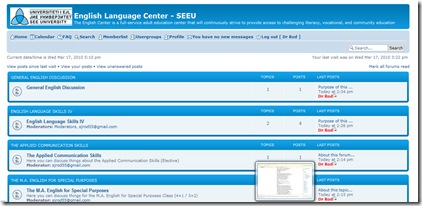
Ardian in Year 2 – Advanced Skills IV class has created the forum listed below for discussion of events in class as well as various other topics. I encourage all my SEE University students to sign on and actively participate – you never know – it might get you extra credit!

http://enforum.justgoo.com/forum.htm

English Forum

William Shakespeare Plays


William Shakespeare the Great Bard of Stratford

William Shakespeare - the Complete Works

Shakespeare Site Map
Shakespeare Biography
Bubonic Plague
Shakespeare Sonnets

First Folio
Shakespearean Insults!
Pictures of Shakespeare
Shakespeare Poems

Shakespeare Facts
Shakespeare Dictionary
Globe Theater
Identity Problem

Shakespeare Quotes
Shakespeare Quiz!
Elizabethan Theater
Shakespeare Forum

The Plays of William Shakespeare  
The plays written by the great Bard are listed below by category and alphabetical order. The section relating to the Chronology of Plays provides a list of when plays were written and published. This section provides access to the plot summary of each play, pictures, key dates, characters, history and the full script of every one of William Shakespeare's plays.

History themed Plays
Click a link below to access full scripts and information about Shakespeare's Plays

Tragedy themed Plays
Click a link below to access full scripts and information about Shakespeare's Plays

Comedy themed Plays
Click a link below to access full scripts and information about Shakespeare's Plays

Registration of Plays

Plays were required to be registered prior to publication. It was important that plays were regulated as  playwrights used the stage as a forum to express their own views on religion and politics. Registration provided an opportunity to invoke a form of censorship and the means to suppress too much freedom of thought and criticism of the crown and public affairs.

Information provided about the plays

The Bard never published any of his plays and therefore none of the original manuscripts have survived. Eighteen unauthorised versions of his plays were, however, published during his lifetime in quarto editions by unscrupulous publishers (there were no copyright laws protecting Shake-speare and his works during the Elizabethan era). A collection of his works did not appear until 1623 (a full seven years after Shakespeare's death on April 23, 1616) when two of his fellow actors, John Hemminges and Henry Condell, posthumously recorded his work and published 36 of William’s plays in the First Folio. Some dates are therefore approximate other dates are substantiated by historical events, records of performances and the dates plays appeared in print.

The Characters and Scripts
These enduring works  feature many famous and well loved characters. The text and scripts convey vivid impressions. The language used today is, in many ways, different to that used in the 16th century Elizabethan era and this is often reflected in the script and text used in the plays. It is therefore not surprising that we have no experience or  understanding of some of the words contained in the text / script of the various works. We have therefore included a Shakespearean Dictionary for most of the more obscure words used in the script of his plays, some of which are obsolete in modern language or Dictionaries. Make a note of any unusual words that you encounter whilst reading the scripts and check their definition in the Dictionary by clicking Dictionary at the top of the page to access
Elizabethan Dictionary - Guide to language and words used in the Elizabethan era.

Chronology of Plays
The section relating to the Chronology of Plays provides a list of when plays were written and published. This section provides access to the plot summary of each of the plays, pictures, key dates, characters, history and the full script of every one of William Shake-speare's plays. 

Chronology of Plays - First performance and publications

Editions of Plays
This selection of Collections of Shake-speare conveys the number of different editions of the Plays of the Bard that have been published. Editions may vary in content and variations are generally detailed and explained in the modern forewords.1623 The First Folio (F1) 
1632 The Second Folio (F2) 
1663 The Third Folio (F3) Second issue of the F3 in the following year includes Pericles. 
1685 The Fourth Folio (F4)
1709 Nicholas Rowe's edition
1723-25 Alexander Pope's edition. 
1733 Lewis Theobald's edition. 
1734-5 Robert Walker's small-format editions of the individual plays
1734-6 Jacob Tonson
1743-4 Thomas Hanmer's edition.
1747 William Warburton's edition. 
1765 Samuel Johnson's edition. 
1767-8 Edward Capell's edition.
1773 George Stevens's revision of Samuel Johnson's edition. 
1773-4 John Bell's edition - Based on the prompt books then being used in the London theatres. 
1778 Isaac Reed's revision of Stevens's Johnson edition. 
1790 Edmond Malone's edition.
1791-1802 J. & J. Boydell's edition.
1795 First American edition published at Philadelphia. 
1807 Francis Douce's edition
1821 A revised edition of Malone, prepared by James Boswell.
1822-23 Pickering edition.
1838-43 Charles Knight's edition.
1859-60 Mary Cowden Clarke's edition.
1863-6 Clark, Wright and Glover Cambridge University Press edition.
1870-1911 William J. Rolfe edition 
1899-1931 W. J. Craig and R. H. Case's 'The Arden Shakespeare'.
1921-66 John Dover Wilson and Arthur Quiller-Couch's 'New Cambridge Shakespeare'.
1937-59 George B. Harrison's 'Penguin Shakespeare'.
1951 Peter Alexander's edition.
1956-67 Alfred Harbage's 'Pelican Shakespeare'. 
1974 G. Blakemore Evans's 'Riverside Shakes-peare'.The edition most widely used among US colleges  
1986 Stanley Wells and Gary Taylor's 'Oxford Shakespeare'.
1995- Richard Proudfoot, Ann Thompson and David Scott Kastan's revision of the Arden (now known as 'Arden 3').

First Folio - Description of William Shakespeare Quarto Texts and first published plays as Comedies, Histories and Tragedies

Plays and the Globe Theatre
Plays were big!! There was money to be made!! There was a constant demand for new material!! Rivalry between the Theatres Playhouses was enormous!! As soon as plays were written they was immediately produced - printing followed productions! So the actors initially used 'foul papers' or prompts. Rival theater companies would send their members to attend plays to produce unauthorised copies of plays - notes were made and copied as quickly as possible. In Shakespeare’s time copyright did not exist. Alternative versions of Shakespearean plays were produced! These unauthorised and inferior text copies of Shakespeare's plays are called Quarto Texts.

The success of the Elizabethan theaters, including that of the Globe, was such that other  forms of Elizabethan entertainment were being seriously affected. In 1591 the growing popularity of theatres led to a law closing all theaters on Thursdays so that the bull and bear bating industries would not be neglected! Many of the plays of the Great Playwright were first featured in the Globe Theatre of London.

Comedies, Histories and Tragedies

William Shakespeare Plays

Wednesday, March 10, 2010

English for Specific Purposes – 2010 - M.A. ELT Program (4+1 / 3+2)

clip_image001

Faculty of Teacher Training - English Department

Course Title: English for Specific Purposes – 2010 - M.A. ELT Program (4+1 / 3+2)

Instructor: Dr. Rod

E-mail: sjrod55@gmail.com

DRAFT OUTLINE

*The instructor reserves the right to change the syllabus as the course progresses if necessary

Course Overview and Objectives:

English for Specific Purposes (ESP) is known as a learner-centered approach to teaching English as a foreign or second language. It meets the needs of adult learners who need to learn a foreign language for use in their specific fields, such as science, technology, medicine, leisure, and academic learning. This course is recommended for graduate students and foreign and second language professionals who wish to learn how to design ESP courses and programs in an area of specialization such as English for business, Engineering, and for Academic Purposes. In addition, they are introduced to ESP instructional strategies, materials adaptation and development, and evaluation.

Its objectives include:

  • To develop an understanding about the factors that led to the emergence of ESP and the forces, both theoretical and applied, that have shaped its subsequent development.
  • To assist students develop needs assessments and genre analyses for specific groups of learners.
  • To provide guidelines to adapt or create authentic ESP materials in a chosen professional or occupational area and to critically evaluate currently available materials
  • To become knowledgeable about assessment procedures appropriate for ESP and apply this knowledge in developing course and lesson evaluation plans in their professional or occupational area.
  • To assist students in preparing a syllabus, lesson and assessment plan based upon their needs assessments and genre analyses.

Knowledge and Understanding:

Learning Outcomes
A1 : Knowledge of key principles involving the historical development and existing practice in ESP
A2 : A detailed acquaintance of genres spanning written/spoken discourse and a variety of specialised contexts (academic and non-academic) in which English is taught and used
A3 : An appreciation of the strategies employed by ESP learners in different disciplines and of the roles of ESP teachers
A4 : An understanding of how the above apply to particular teaching situations, especially those that the student is familiar with, in the context of accepted contemporary professional practice

Teaching Methods
1-4 are taught initially through staff-led modules, using a variety of means of delivery (formal lecture, seminar, question-answer discussion session, group-work task-based session, computer lab session, student oral reports, workshop). 4 is enhanced by classroom observation where possible. Staff feedback to students on coursework is a connected important feature enhancing learning. Learning is expected to be deepened through directed and independent self-access library study and use of web material both put up by staff and generally available on the internet.

Intellectual / Cognitive Skills:

Learning Outcomes
B1 : Critical skills needed to evaluate disparate sources of information, both academic (e.g. lectures, books) and experiential, and collate, select, and apply the information to a specific teaching issue or situation critical skills needed to evaluate disparate sources of information, both academic (e.g. lectures, books) and experiential, and collate, select, and apply the information to a specific teaching issue or situation
B2 : An ability to formulate coherent and logically sound arguments
B3 : Ability to reflect independently on own teaching/learning experience and relate it to the ideas and research in the field
B4 : Ability to identify a research question or hypothesis, choose appropriate research methods, and interpret own and others' data and see the implications for a hypothesis or question

Teaching Methods
1-4 are fostered repeatedly by all the means of teaching/learning described in (A)

Practical Skills:

Learning Outcomes
C1 : Ability to seek and retrieve relevant information from a variety of sources (e.g. library, journals, WWW)
C2 : Ability to communicate lucidly in speech and writing about theoretical matters, teaching and learning issues and own teaching experience, in appropriate style
C3 : Practical skills in analysing the core properties of syllabuses and materials in different language learning/teaching situations
C4 : Ability to propose, plan, execute and write up an original, complete but limited study related to ESP with due treatment of appropriate prior research and theory, generation of research aims, application of relevant methods (e.g. empirical data gathering, or syllabus/materials design or evaluation) and management and presentation of the whole project with due attention to proper professional practice and ethics.

Teaching Methods
1 is promoted by staff guidance as well as being guided by staff teaching, and giving advice
2 is promoted by the oral and written tasks associated with the taught modules, and feedback on them, and by guidance in course booklet and an unassessed module on assignment and dissertation writing
3 is dealt with by embedding practical data analysis tasks into specialist modules.
4 is promoted by supervision of the obligatory dissertation
1-4 are further supported by advice from me in consultation hours or by email, and by web-based self-access material.

Key Skills:

Learning Outcomes
D1 : a. Oral participation in group discussion and lectures b. Academic writing, both in the form of argumentative academic papers and research reports, in appropriate style c. Critical reading: researching and utilising information, including scanning, recognising opinion and bias, detecting relevant points, collating different sources.
D2 : Using advanced computational tools and software packages to obtain, store and process information stored in electronic form (e.g. from the Library, WWW or CD-rom).

D3 : a. Analysis of tasks and identification of objectives b. Identification and use of relevant information sources c. Establishing main features of a complex problem d. Planning and selection of approach to reach a solution
D4 : Participation in pair/group class tasks (including organising and evaluating own and others' contributions)
D5 : a. Use of independent time management skills, initiative, and different approaches to working autonomously to meet assignment and dissertation targets b. Use of feedback and support from peers, lecturers and supervisor to meet targets and improve over the year

Teaching Methods
1 and 5 are promoted by many taught modules, and involve listening and note taking in lectures. They are also facilitated by feedback.
2 is promoted mainly by self access material on WWW. More generically, students will be expected to become familiar with basic PC management and the word processing of academic documents, internet searching, etc. in connection with their work for all modules.
4 and 6 are promoted via the assignments which impose requirements for students to apply these skills
1-2 and 4-6 are all further practised for the dissertation, and aided when necessary by staff advice by email or consultation

Attendance policy:

In accordance with the university’s attendance policy, students must attend 70% of the meetings in order to be able to pass the course.  If a student misses more than 30 % of the classes, the student will automatically fail the course, regardless of performance on the assignments.  The dismissal of excused absences (medical appointments, family emergencies, etc.) will be taken up on a case by case basis.

Academic Dishonesty

An incident of academic dishonesty occurs when a student commits any of the following acts (this list does not preclude other acts of academic fraud):

1. Cheating refers to the use or attempted use of unauthorized materials, information, or study aids in an academic exercise or assignment.

2. Fabrication refers to the unauthorized falsification or invention of any information or citation in an academic exercise.

3. Facilitating academic dishonesty is the act of helping or attempting to help another to violate any provision of the institutional policy on academic dishonesty.

4. Plagiarism describes the unacknowledged adoption or reproduction of the ideas, words, statements of another person, including classroom peers.

Students caught engaging in academic dishonesty once will fail the assignment. Two or more incidents of academic dishonesty will result in failure of the course.

Assessment:

Grade Scale

Grade Description

Grade Points

95% - 100%

Excellent

10.0

86% - 94%

Very good

9.0

77% - 85%

Good

8.0

68% - 76%

Satisfactory

7.0

60% - 67%

Passing

6.0

Assessment in this course will be continuous (ongoing).  Students therefore should be advised that each and every meeting is crucial to their success in the course.  The students will be assessed for these components:

Please be well aware that while there will not be formalized mid and final year examinations, the continuous assessments, in total, have the same effect and weigh equally.

Grading Rubric:

Attendance

10 %

Homework

20 %

Participation

20 %

Debate

10 %

Writing assignments

40 %

Total

100 %

Course Outline:

Session 1

  • Introductions and backgrounds
  • ESP: Teaching to perceived needs and imagined futures in worlds of work, study and everyday life
  • How is ESP different from ESL
  • Syllabus and course outline

Session 2

  • What is ESP?
  • Needs Analysis and Course Design
  • Identifying as completely as possible a real group of English language learners.
  • Give and receive feedback on each other’s target population.

Session 3

Discussing issues related to the design of needs analysis tools for your specific group of learners

Assignment 1: Design a needs analysis plan for your target population that you would carry out if you had sufficient time and money.

Session 4

  • Defining what genre is and operationally identifying different types of genre.
  • Discussing issues related to planning, conceptualizing, developing, implementing and evaluating ESP programs.

Assignment 2: Find written or spoken texts for analysis that are appropriate for your learners and conduct genre analysis

Session 5

Discussing how the results of your needs analysis help setting the parameters of your ESP course design. Give and receive feedback.

Assignment 3: Propose a course design plan

Session 6

  • Discussing factors involved in the identification of ESP materials.
  • Discussing issues related to how technology can enhance teaching ESP, and important points to consider when integrating technology into classroom practice.

Assignment 4: Write a reflection paper on selecting materials for your target population

Session 7

  • Discussing student evaluation methods
  • Discussing issues related to the evaluation of the ESP course

Incomplete (IN): An incomplete grade may be assigned if a student has not finished all course requirements by the end of the semester, but has completed a substantial amount of the work. It is the student’s responsibility to bring pertinent information to the teacher and to reach an agreement on how the remaining course requirements will be satisfied. If requirements are not completed within one year, a failing grade is automatically assigned.

Recommended reading:

English for Specific Purposes by Keith Harding –

Oxford University Press 2007.

ISBN – 13: 987 019 442575 9 and ISBN – 10: 0 19 442575 9

Articles:

Basturkmen, H. (1998). Refining procedures: A needs analysis project at Kuwait University. English Teaching Forum, 36(4). Also available at: http://exchanges.state.gov/forum/vols/vol36/no4/p2.htm

Bhatia, V. K. (1997). Applied genre analysis and ESP. In T. Miller (Ed.), Functional approaches to written text: Classroom applications (pp. 134-149). English Language Programs: United States Information Agency. Also available at: http://exchanges.state.gov/education/engteaching/pubs/BR/functionalsec4_10.htm

Bosher, S. & Smalkoski, K. (2002). From needs analysis to curriculum development: Designing a course in health-care communication for immigrant students in the USA. English for Specific Purposes, 21(1): 59-79. (can be accessed online from IU Library website with an IU account)

Douglas, D. (1999) Assessing Languages for Specific Purposes CUP
Dudley-Evans,T and M. St. John (1998) Developments in ESP: a Multi-Disciplinary Approach C UP

Dudley-Evans, T. (2000). Genre analysis: A key to a theory of ESP? Iberica, 2, 3-11. Also available at: www.uv.es/aelfe/WebRAs/RA-2-Dudley.pdf

Hutchinson, T. and A. Waters (1997) English for Specific Purposes, CUP

Johns, A. M. (1991). English for specific purposes (ESP): Its history and contributions. In M. Celce-Murcia (Ed.), Teaching English as a second or foreign language (2nd ed., pp. 67-77). New York: Newbury House.

Johns, A. M., & Price-Machada, D. (2001). English for specific purposes (ESP): Tailoring courses to students' needs-and to the outside world. In M. Celce-Murcia (Ed.), Teaching English as a second or foreign language (3rd ed., pp. 43-54). Boston: Heinle & Heinle.

Mackay , R and A Mountford (Eds) (1978) English for Specific Purposes Longman

McDonough, J. (1984) ESP in Perspective. Collins

Munby, J (1978) Communicative Syllabus Design CUP

Richterich, R (Ed.) (1983) Case Studies in Identifying Language Needs Pergamon

Robinson, P. (1991) ESP: A Practitioner's Guide. Prentice Hall International

Swales, J (1985) Episodes in ESP Pergamon

West, R. (1994). Needs analysis in language teaching. Language Teaching 27(1): 1-19.

Tuesday, March 9, 2010

Listening Skills week 2 – Air Traffic Control.

clip_image001


Faculty of Teacher Training - English Department

Course Title: Advanced English Language IV

Instructor: Dr. Rod

E-mail: sjrod55@gmail.com


Below are samples from the notes given to act as a reminder. You already have the printed full transcript.

TRANSCRIPT

Air traffic control communication at Portland International Airport - July 1, 1990
Researchers: Karen Ward, David Novick, Carolyn Sousa
Department of Computer Science and Engineering Oregon Graduate Institute

Introduction


This report contains a transcript of radio communications between air traffic controllers and pilots. The transcript was prepared as part of the ATC Interaction Research Project (AIR Project) at the Oregon Graduate Institute, which has been investigating computational representations of Air Traffic Control (ATC) communication.


This transcript covers 30 minutes of the radio communications of one controller in the Portland International Airport (PDX) Terminal Radar Control (TRACON) Facility. The controller was
working one of the two approach positions; that is, he was responsible for aircraft entering and leaving a portion of the PDX Approach Radar Service Area (ARSA).

The transcript was made from a recording taped from radio at a site approximately two NM from the airport on July 1, 1990, between 10:45 and 11:15 AM. A copy of this recording on cassette
may be obtained by writing to the Department of Computer Science and Engineering of the Oregon Graduate Institute. The recording exhibits high-frequency cutoff and high noise levels, however, so it may not be suitable for direct use with speech recognizers.

The transcript is in two parts. The section entitled “Full Transcript” depicts all exchanges chronologically as they occurred. However, air traffic control dialogue can be viewed as many interleaved yet fairly independent conversations, so in the “Separated Transcripts” section utterances are grouped by aircraft to show the course of each individual conversation. The utterance numbers from the full transcript are preserved in the separated transcripts so that the utterance context may be located easily

Full Transcript


(1) Unknown: (-forty) five.
(2) Approach: Horizon sixty four turn right heading one two zero.
(3) Horizon 64: Turn right one two zero Horizon sixty four.
(4) Horizon 391: Horizon uh, three ninety one (uh we’d like to) uh join the localizer.
(5) Approach: Horizon three ninety one turn right heading three one zero join the localizer.
(6) Horizon 391: Three one zero. (Three) ninety one.
(7) Approach: Horizon three ninety one you’re eight miles from uh, Laker maintain three thousand till established localizer cleared ILS two eight right approach.
(8) Horizon 391: Cleared the ILS, two eight right approach three thousand till establish. Horizon Air three ninety one.
(9) Approach: -ska two oh five turn left heading three two zero.
(10) Alaska 205: Three two zero, Alaska two oh five.
(11) Approach: Alaska six zero four reduce speed to one five zero until Laker and contact tower one one eight point seven.
(12) Alaska 604: Slowing to uh one fifty and uh, tower uh, eighteen seven for Alaska six zero four.
(13) Approach: Horizon three ninety one maintain one seven zero knots until Laker.
(14) Horizon 391: One seventy till Laker, Horizon three ninety one.
(15) Approach: Horizon sixty four turn: correction uh, continue on your present heading.
(16) Horizon 64: ((garbled))
(17) Unknown: ((Mike depressed))

(18) Horizon 391: Horizon three ninety one has the field in sight.
(19) Approach: Horizon three ninety one roger cross abeam of Laker at or above, two thousand, you’re cleared for the visual approach runway two eight left.
(20) Horizon 391: Laker at or above two thousand, cleared the visual to the left, roger three ninety one.
(21) Approach: Alaska two zero five (practical) increase speed to one niner zero until Laker.
(22) Alaska 205: Alaska two oh five reduce- uh increasing.
(23) Approach: Delta seven forty five turn right heading two eight zero, join the localizer.
(24) Delta 745: Right two eighty, join the localizer, Delta seven forty five.
(25) Horizon 391: Three ninety one, can we pick it up, (just a) little bit.
(26) Approach: Horizon three ninety one, uh that’s approved.
(27) Horizon 391: Horizon three ninety one, (roger).
(28) Unknown: ((Mike depressed))
(29) Unknown: ((squawk))
(30) Approach: ((garbled)) zero papa service terminated squawk twelve hundred, frequency change approved.
(31) Approach: Horizon sixty four turn left heading zero, six zero.
(32) Horizon 64: Zero six zero, Horizon, uh, sixty four.
(33) Approach: Alaska two oh five, nine from Laker, maintain three thousand till established on the localizer cleared the ILS two eight right approach, maintain speed (of) one eight zero until Laker.

(34) Alaska 205: Roger Alaska two oh five, uh, cleared approach three thousand till established on the localizer at three thousand, and uh hundred ‘n uh ninety till Laker?
(35) Approach: Alaska two zero five, uh turn left heading two five zero now to join the localizer and maintain three thousand
till established on the localizer, cleared ILS two eight right approach, maintain speed one eight zero until Laker.
(36) Alaska 205: Roger one eighty, till Laker Alaska two oh five copy the rest.
(37) Approach: Horizon sixty four turn left heading three one zero join the localizer.
(38) Horizon 64: Three ten and join Horizon sixty four.
(39) Approach: Tingle one (four eight) Portland Approach, r:oger, fly your present heading and reduce speed to two one zero.
(40) Approach: Tingle one (four eight) thank you.
(41) Approach: Delta seven forty five descend and maintain four thousand five hundred.
(42) Delta 745: Down to four thousand five hundred Delta seven forty five.
(43) Approach: Horizon, uh disregard.
(44) Approach: Delta seven forty five is one zero miles from Laker, maintain four thousand five hundred till established on the localizer, cleared ILS two eight right approach, maintain speed one, seven zero until Laker.
(45) Delta 745: One seventy till Laker forty five hundred (descending fifty seven) uh, ILS twenty eight right Delta seven forty five.

Listening Skills Week 2

clip_image001


Faculty of Teacher Training - English Department

Course Title: Advanced English Language IV

clip_image002Instructor: Dr. Rod

E-mail: sjrod55@gmail.com

Obama inaugural speech

Barack Obama 44th US president. Here is his inauguration speech in full.

My fellow citizens:

I stand here today humbled by the task before us, grateful for the trust you have bestowed, mindful of the sacrifices borne by our ancestors. I thank President Bush for his service to our nation, as well as the generosity and co-operation he has shown throughout this transition.

Forty-four Americans have now taken the presidential oath. The words have been spoken during rising tides of prosperity and the still waters of peace. Yet, every so often the oath is taken amidst gathering clouds and raging storms.

At these moments, America has carried on not simply because of the skill or vision of those in high office, but because we, the people, have remained faithful to the ideals of our forbears, and true to our founding documents.

So it has been. So it must be with this generation of Americans.

Serious challenges

That we are in the midst of crisis is now well understood. Our nation is at war, against a far-reaching network of violence and hatred. Our economy is badly weakened, a consequence of greed and irresponsibility on the part of some, but also our collective failure to make hard choices and prepare the nation for a new age. Homes have been lost; jobs shed; businesses shuttered. Our healthcare is too costly; our schools fail too many; and each day brings further evidence that the ways we use energy strengthen our adversaries and threaten our planet.

“ We have chosen hope over fear, unity of purpose over conflict and discord ”

These are the indicators of crisis, subject to data and statistics. Less measurable but no less profound is a sapping of confidence across our land - a nagging fear that America's decline is inevitable, that the next generation must lower its sights.

Today I say to you that the challenges we face are real. They are serious and they are many. They will not be met easily or in a short span of time. But know this, America - they will be met.

On this day, we gather because we have chosen hope over fear, unity of purpose over conflict and discord.

On this day, we come to proclaim an end to the petty grievances and false promises, the recriminations and worn-out dogmas, that for far too long have strangled our politics.

Nation of 'risk-takers'

We remain a young nation, but in the words of scripture, the time has come to set aside childish things. The time has come to reaffirm our enduring spirit; to choose our better history; to carry forward that precious gift, that noble idea, passed on from generation to generation: the God-given promise that all are equal, all are free, and all deserve a chance to pursue their full measure of happiness.

In reaffirming the greatness of our nation, we understand that greatness is never a given. It must be earned. Our journey has never been one of short-cuts or settling for less. It has not been the path for the faint-hearted - for those who prefer leisure over work, or seek only the pleasures of riches and fame. Rather, it has been the risk-takers, the doers, the makers of things - some celebrated but more often men and women obscure in their labour, who have carried us up the long, rugged path towards prosperity and freedom.

For us, they packed up their few worldly possessions and travelled across oceans in search of a new life.

For us, they toiled in sweatshops and settled the West; endured the lash of the whip and ploughed the hard earth.

For us, they fought and died, in places like Concord and Gettysburg; Normandy and Khe Sahn.

'Remaking America'

Time and again these men and women struggled and sacrificed and worked till their hands were raw so that we might live a better life. They saw America as bigger than the sum of our individual ambitions; greater than all the differences of birth or wealth or faction.

“ The state of the economy calls for action, bold and swift ”

This is the journey we continue today. We remain the most prosperous, powerful nation on Earth. Our workers are no less productive than when this crisis began. Our minds are no less inventive, our goods and services no less needed than they were last week or last month or last year. Our capacity remains undiminished. But our time of standing pat, of protecting narrow interests and putting off unpleasant decisions - that time has surely passed. Starting today, we must pick ourselves up, dust ourselves off, and begin again the work of remaking America.

For everywhere we look, there is work to be done. The state of our economy calls for action, bold and swift, and we will act - not only to create new jobs, but to lay a new foundation for growth. We will build the roads and bridges, the electric grids and digital lines that feed our commerce and bind us together. We will restore science to its rightful place, and wield technology's wonders to raise healthcare's quality and lower its cost. We will harness the sun and the winds and the soil to fuel our cars and run our factories. And we will transform our schools and colleges and universities to meet the demands of a new age. All this we can do. All this we will do.

Restoring trust

Now, there are some who question the scale of our ambitions - who suggest that our system cannot tolerate too many big plans. Their memories are short. For they have forgotten what this country has already done; what free men and women can achieve when imagination is joined to common purpose, and necessity to courage.

“ We reject as false the choice between our safety and our ideals ”

What the cynics fail to understand is that the ground has shifted beneath them - that the stale political arguments that have consumed us for so long no longer apply.

The question we ask today is not whether our government is too big or too small, but whether it works - whether it helps families find jobs at a decent wage, care they can afford, a retirement that is dignified. Where the answer is yes, we intend to move forward. Where the answer is no, programmes will end. And those of us who manage the public's dollars will be held to account - to spend wisely, reform bad habits, and do our business in the light of day - because only then can we restore the vital trust between a people and their government.

Nor is the question before us whether the market is a force for good or ill. Its power to generate wealth and expand freedom is unmatched, but this crisis has reminded us that without a watchful eye, the market can spin out of control - that a nation cannot prosper long when it favours only the prosperous. The success of our economy has always depended not just on the size of our gross domestic product, but on the reach of our prosperity; on the ability to extend opportunity to every willing heart - not out of charity, but because it is the surest route to our common good.

'Ready to lead'

As for our common defence, we reject as false the choice between our safety and our ideals. Our founding fathers, faced with perils that we can scarcely imagine, drafted a charter to assure the rule of law and the rights of man, a charter expanded by the blood of generations. Those ideals still light the world, and we will not give them up for expedience's sake. And so to all the other peoples and governments who are watching today, from the grandest capitals to the small village where my father was born: know that America is a friend of each nation and every man, woman, and child who seeks a future of peace and dignity, and we are ready to lead once more.

“ We will not apologise for our way of life, nor will we waver in its defence ”

Recall that earlier generations faced down fascism and communism not just with missiles and tanks, but with the sturdy alliances and enduring convictions. They understood that our power alone cannot protect us, nor does it entitle us to do as we please. Instead, they knew that our power grows through its prudent use; our security emanates from the justness of our cause, the force of our example, the tempering qualities of humility and restraint.

We are the keepers of this legacy. Guided by these principles once more, we can meet those new threats that demand even greater effort - even greater co-operation and understanding between nations. We will begin to responsibly leave Iraq to its people, and forge a hard-earned peace in Afghanistan. With old friends and former foes, we will work tirelessly to lessen the nuclear threat, and roll back the spectre of a warming planet. We will not apologise for our way of life, nor will we waver in its defence, and for those who seek to advance their aims by inducing terror and slaughtering innocents, we say to you now that our spirit is stronger and cannot be broken; you cannot outlast us, and we will defeat you.

'Era of peace'

For we know that our patchwork heritage is a strength, not a weakness. We are a nation of Christians and Muslims, Jews and Hindus - and non-believers. We are shaped by every language and culture, drawn from every end of this earth; and because we have tasted the bitter swill of civil war and segregation, and emerged from that dark chapter stronger and more united, we cannot help but believe that the old hatreds shall someday pass; that the lines of tribe shall soon dissolve; that as the world grows smaller, our common humanity shall reveal itself; and that America must play its role in ushering in a new era of peace.

To the Muslim world, we seek a new way forward, based on mutual interest and mutual respect. To those leaders around the globe who seek to sow conflict, or blame their society's ills on the West - know that your people will judge you on what you can build, not what you destroy. To those who cling to power through corruption and deceit and the silencing of dissent, know that you are on the wrong side of history; but that we will extend a hand if you are willing to unclench your fist.

To the people of poor nations, we pledge to work alongside you to make your farms flourish and let clean waters flow; to nourish starved bodies and feed hungry minds. And to those nations like ours that enjoy relative plenty, we say we can no longer afford indifference to the suffering outside our borders; nor can we consume the world's resources without regard to effect. For the world has changed, and we must change with it.

'Duties'

As we consider the road that unfolds before us, we remember with humble gratitude those brave Americans who, at this very hour, patrol far-off deserts and distant mountains. They have something to tell us, just as the fallen heroes who lie in Arlington whisper through the ages. We honour them not only because they are the guardians of our liberty, but because they embody the spirit of service; a willingness to find meaning in something greater than themselves. And yet, at this moment - a moment that will define a generation - it is precisely this spirit that must inhabit us all.

“ What is required of us now is a new era of responsibility ”

For as much as government can do and must do, it is ultimately the faith and determination of the American people upon which this nation relies. It is the kindness to take in a stranger when the levees break, the selflessness of workers who would rather cut their hours than see a friend lose their job which sees us through our darkest hours. It is the firefighter's courage to storm a stairway filled with smoke, but also a parent's willingness to nurture a child, that finally decides our fate.

Our challenges may be new. The instruments with which we meet them may be new. But those values upon which our success depends - honesty and hard work, courage and fair play, tolerance and curiosity, loyalty and patriotism - these things are old. These things are true. They have been the quiet force of progress throughout our history. What is demanded then is a return to these truths.

What is required of us now is a new era of responsibility - a recognition, on the part of every American, that we have duties to ourselves, our nation, and the world, duties that we do not grudgingly accept but rather seize gladly, firm in the knowledge that there is nothing so satisfying to the spirit, so defining of our character, than giving our all to a difficult task.

'Gift of freedom'

This is the price and the promise of citizenship.

This is the source of our confidence - the knowledge that God calls on us to shape an uncertain destiny.

This is the meaning of our liberty and our creed - why men and women and children of every race and every faith can join in celebration across this magnificent mall, and why a man whose father less than 60 years ago might not have been served at a local restaurant can now stand before you to take a most sacred oath.

So let us mark this day with remembrance, of who we are and how far we have travelled. In the year of America's birth, in the coldest of months, a small band of patriots huddled by dying campfires on the shores of an icy river. The capital was abandoned. The enemy was advancing. The snow was stained with blood. At a moment when the outcome of our revolution was most in doubt, the father of our nation ordered these words be read to the people:

"Let it be told to the future world... that in the depth of winter, when nothing but hope and virtue could survive... that the city and the country, alarmed at one common danger, came forth to meet [it]."

America. In the face of our common dangers, in this winter of our hardship, let us remember these timeless words. With hope and virtue, let us brave once more the icy currents, and endure what storms may come. Let it be said by our children's children that when we were tested we refused to let this journey end, that we did not turn back nor did we falter; and with eyes fixed on the horizon and God's grace upon us, we carried forth that great gift of freedom and delivered it safely to future generations.

Thank you. God bless you. And God bless the United States of America.

Story from BBC NEWS:
http://news.bbc.co.uk/go/pr/fr/-/2/hi/americas/obama_inauguration/7840646.stm

Listening Skills Week 2

Faculty of Teacher Training - English Department

Course Title: Advanced English Language IV

Instructor: Dr. Rod

E-mail: sjrod55@gmail.com

clip_image002I have a Dream – Martin Luther King Jnr.

Delivered 28 August 1963, at the Lincoln Memorial, Washington D.C.

AUTHENTICITY CERTIFIED: Text version below transcribed directly from audio

I am happy to join with you today in what will go down in history as the greatest demonstration for freedom in the history of our nation.

Five score years ago, a great American, in whose symbolic shadow we stand today, signed the Emancipation Proclamation. This momentous decree came as a great beacon light of hope to millions of Negro slaves who had been seared in the flames of withering injustice. It came as a joyous daybreak to end the long night of their captivity.

But one hundred years later, the Negro still is not free. One hundred years later, the life of the Negro is still sadly crippled by the manacles of segregation and the chains of discrimination. One hundred years later, the Negro lives on a lonely island of poverty in the midst of a vast ocean of material prosperity. One hundred years later, the Negro is still languished in the corners of American society and finds himself an exile in his own land. And so we've come here today to dramatize a shameful condition.

In a sense we've come to our nation's capital to cash a check. When the architects of our republic wrote the magnificent words of the Constitution and the Declaration of Independence, they were signing a promissory note to which every American was to fall heir. This note was a promise that all men, yes, black men as well as white men, would be guaranteed the "unalienable Rights" of "Life, Liberty and the pursuit of Happiness." It is obvious today that America has defaulted on this promissory note, insofar as her citizens of color are concerned. Instead of honoring this sacred obligation, America has given the Negro people a bad check, a check which has come back marked "insufficient funds."

But we refuse to believe that the bank of justice is bankrupt. We refuse to believe that there are insufficient funds in the great vaults of opportunity of this nation. And so, we've come to cash this check, a check that will give us upon demand the riches of freedom and the security of justice.

We have also come to this hallowed spot to remind America of the fierce urgency of Now. This is no time to engage in the luxury of cooling off or to take the tranquilizing drug of gradualism. Now is the time to make real the promises of democracy. Now is the time to rise from the dark and desolate valley of segregation to the sunlit path of racial justice. Now is the time to lift our nation from the quicksands of racial injustice to the solid rock of brotherhood. Now is the time to make justice a reality for all of God's children.

It would be fatal for the nation to overlook the urgency of the moment. This sweltering summer of the Negro's legitimate discontent will not pass until there is an invigorating autumn of freedom and equality. Nineteen sixty-three is not an end, but a beginning. And those who hope that the Negro needed to blow off steam and will now be content will have a rude awakening if the nation returns to business as usual. And there will be neither rest nor tranquility in America until the Negro is granted his citizenship rights. The whirlwinds of revolt will continue to shake the foundations of our nation until the bright day of justice emerges.

But there is something that I must say to my people, who stand on the warm threshold which leads into the palace of justice: In the process of gaining our rightful place, we must not be guilty of wrongful deeds. Let us not seek to satisfy our thirst for freedom by drinking from the cup of bitterness and hatred. We must forever conduct our struggle on the high plane of dignity and discipline. We must not allow our creative protest to degenerate into physical violence. Again and again, we must rise to the majestic heights of meeting physical force with soul force.

The marvelous new militancy which has engulfed the Negro community must not lead us to a distrust of all white people, for many of our white brothers, as evidenced by their presence here today, have come to realize that their destiny is tied up with our destiny. And they have come to realize that their freedom is inextricably bound to our freedom.

We cannot walk alone.

And as we walk, we must make the pledge that we shall always march ahead.

We cannot turn back.

There are those who are asking the devotees of civil rights, "When will you be satisfied?" We can never be satisfied as long as the Negro is the victim of the unspeakable horrors of police brutality. We can never be satisfied as long as our bodies, heavy with the fatigue of travel, cannot gain lodging in the motels of the highways and the hotels of the cities. We cannot be satisfied as long as the negro's basic mobility is from a smaller ghetto to a larger one. We can never be satisfied as long as our children are stripped of their self-hood and robbed of their dignity by signs stating: "For Whites Only." We cannot be satisfied as long as a Negro in Mississippi cannot vote and a Negro in New York believes he has nothing for which to vote. No, no, we are not satisfied, and we will not be satisfied until "justice rolls down like waters, and righteousness like a mighty stream."¹

I am not unmindful that some of you have come here out of great trials and tribulations. Some of you have come fresh from narrow jail cells. And some of you have come from areas where your quest -- quest for freedom left you battered by the storms of persecution and staggered by the winds of police brutality. You have been the veterans of creative suffering. Continue to work with the faith that unearned suffering is redemptive. Go back to Mississippi, go back to Alabama, go back to South Carolina, go back to Georgia, go back to Louisiana, go back to the slums and ghettos of our northern cities, knowing that somehow this situation can and will be changed.

Let us not wallow in the valley of despair, I say to you today, my friends.

And so even though we face the difficulties of today and tomorrow, I still have a dream. It is a dream deeply rooted in the American dream.

I have a dream that one day this nation will rise up and live out the true meaning of its creed: "We hold these truths to be self-evident, that all men are created equal."

I have a dream that one day on the red hills of Georgia, the sons of former slaves and the sons of former slave owners will be able to sit down together at the table of brotherhood.

I have a dream that one day even the state of Mississippi, a state sweltering with the heat of injustice, sweltering with the heat of oppression, will be transformed into an oasis of freedom and justice.

I have a dream that my four little children will one day live in a nation where they will not be judged by the color of their skin but by the content of their character.

I have a dream today!

I have a dream that one day, down in Alabama, with its vicious racists, with its governor having his lips dripping with the words of "interposition" and "nullification" -- one day right there in Alabama little black boys and black girls will be able to join hands with little white boys and white girls as sisters and brothers.

I have a dream today!

I have a dream that one day every valley shall be exalted, and every hill and mountain shall be made low, the rough places will be made plain, and the crooked places will be made straight; "and the glory of the Lord shall be revealed and all flesh shall see it together."2

This is our hope, and this is the faith that I go back to the South with.

With this faith, we will be able to hew out of the mountain of despair a stone of hope. With this faith, we will be able to transform the jangling discords of our nation into a beautiful symphony of brotherhood. With this faith, we will be able to work together, to pray together, to struggle together, to go to jail together, to stand up for freedom together, knowing that we will be free one day.

And this will be the day -- this will be the day when all of God's children will be able to sing with new meaning:

My country 'tis of thee, sweet land of liberty, of thee I sing.

Land where my fathers died, land of the Pilgrim's pride,

From every mountainside, let freedom ring!

And if America is to be a great nation, this must become true.

And so let freedom ring from the prodigious hilltops of New Hampshire.

Let freedom ring from the mighty mountains of New York.

Let freedom ring from the heightening Alleghenies of Pennsylvania.

Let freedom ring from the snow-capped Rockies of Colorado.

Let freedom ring from the curvaceous slopes of California.

But not only that:

Let freedom ring from Stone Mountain of Georgia.

Let freedom ring from Lookout Mountain of Tennessee.

Let freedom ring from every hill and molehill of Mississippi.

From every mountainside, let freedom ring.

And when this happens, when we allow freedom ring, when we let it ring from every village and every hamlet, from every state and every city, we will be able to speed up that day when all of God's children, black men and white men, Jews and Gentiles, Protestants and Catholics, will be able to join hands and sing in the words of the old Negro spiritual:

Free at last! Free at last!

                Thank God Almighty, we are free at last!3