For more information and how to order your copy please write to me at the below link Thank you
ORDER HERE / More Information
Perhaps one of the best resources for reviews and critiques of recent literature is the London ‘Times Literary Supplement’.
Explore the different sections:
This is one of the best resources for anyone associated with education. I strongly recommend this as a great place to start your research.
ERIC provides unlimited access to more than 1.3 million bibliographic records of journal articles and other education-related materials, with hundreds of new records added multiple times per week. If available, links to full text are included.
Within the ERIC Collection, you will find records for:
You may also search special collections from the What Works Clearinghouse and the Regional Educational Laboratories.
ERIC users include education researchers, teachers, librarians, administrators, education policymakers, instructors and students in teacher-preparation programs, parents, the media and business communities, and the general public. The user community conducts more than eight million searches each month through the ERIC Web site and commercial and non-commercial sites.
ERIC indexes education journals, the majority of which are peer-reviewed. Most of these journals are indexed comprehensively - that is, a record for every article in each issue is included in ERIC. Some journals are indexed selectively - that is, only those articles that are education-related are selected for indexing.
Journal records typically include bibliographic data (author, title, date, journal citation, publisher) and an abstract, or short description of the work. A small number of journal publishers also make the full text of an article available at no cost directly through this Web site. The majority of journal articles need to be obtained through library print and electronic holdings or directly from the publisher. To aid in the finding process, ERIC includes Find in a Library and/or Publisher's Web site links at the end of every record with an ISSN number.
In addition to the journal literature, ERIC indexes education-related materials from a variety of sources, including scholarly organizations, professional associations, research centers, policy organizations, university presses, the U.S. Department of Education and other federal agencies, and state and local agencies. Individual contributors submit conference papers, research papers, dissertations, and theses.
Records for these materials typically include bibliographic data (author, title, date, source), an abstract, or short description of the work, and a link to the full text in PDF format. ERIC appreciates the individuals and publishers who have given ERIC permission to display the full text at no charge. For most materials from 2004 forward, if full text is not available in ERIC, links to the publishers' Web sites and to libraries that may have the full text are provided.
Identifying and providing full-text access to this "grey literature" or "fugitive literature" is one of ERIC's signature strengths. Grey literature provides searchers with a wide variety of important information about education. Diverse in format, it ranges from informational materials to very substantive, rigorously researched and reviewed documents, including research syntheses, conference papers, and policy reports. All materials are reviewed and selected in accordance with the ERIC Selection Policy 
The ERIC Web site allows you to search education-related bibliographic records any time at no charge. A growing number of full-text materials are becoming available in the ERIC Collection as PDF documents in ERIC or via links to library holdings and publishers' Web sites.
Faculty of Teacher Training / English Department
Course Title: MA – ESP 4+1 and 3+2
By Kenneth Beare, About.com Guide
Reference: http://esl.about.com/od/teachingenglish/a/l_multiple.htm
The theory of multiple intelligences was developed in 1983 by Dr. Howard Gardner, professor of education at Harvard University. Here is a discussion of the eight different intelligences Dr. Gardner proposes and their relationship to the ESL / EFL classroom. Each explanation is followed by lesson plans or exercises which can be used in class.
Verbal / Linguistic
Explanation and understanding through the use of words.
This is the most common means of teaching. In the most traditional sense, the teacher teaches and the students learn. However, this can also be turned around and students can help each other understand concepts. While teaching to other types of intelligences is extremely important, this type of teaching focuses on using language and will continue to play the primary role in learning English.
Example Lesson Plans
(re)Introducing Phrasal Verbs to ESL Students
Comparative and Superlative Forms
Countable and Uncountable Nouns - Noun Quantifiers
Reading - Using Context
Visual / Spatial
Explanation and comprehension through the use of pictures, graphs, maps, etc.
This type of learning gives students visual clues to help them remember language. In my opinion, the use of visual, spatial and situational clues is probably the reason learning a language in an English speaking country (Canada, USA, England, etc.) is the most effective way to learn English.
Example Lesson Plans
Business Lesson Describing Trends
Using Colored Pens Drawing in the Classroom - Expressions
Finish the Alphabet - Adjective Recognition
Vocabulary Charts
Body / Kinesthetic
Ability to use the body to express ideas, accomplish tasks, create moods, etc.
This type of learning combines physical actions with linguistic responses and are very helpful for tying language to actions. In other words, repeating "I'd like to pay by credit card." in a dialogue is much less effective than having a student act out a role-play in which he pulls out his wallet and says, "I'd like to pay by credit card."
Example Lesson Plans
Lego Building Blocks
Young Learner's Games for ESL Classes - Simon Says
Telephone English
Interpersonal
Ability to get along with others, work with others to accomplish tasks.
Group learning is based on interpersonal skills. Not only do students learn while speaking to others in an "authentic" setting, they develop English speaking skills while reacting to others. Obviously, not all learners have excellent interpersonal skills. For this reason, group work needs to balanced with other activities.
Example Lesson Plans
Conversation Lesson: Multinationals - Help or Hindrance?
Creating a New Society
Guilty - Fun Classroom Conversation Game
Let's Do Tourism
Logical / Mathematical
Use of logic and mathematical models to represent and work with ideas.
Grammar analysis falls into this type of learning style. Many teachers feel that English teaching syllabi are too loaded towards grammar analysis which has little to do with communicative ability. Nonetheless, using a balanced approach, grammar analysis has it's place in the classroom. Unfortunately, because of certain standardized teaching practices, this type of teaching sometimes tends to dominate the classroom.
Example Lesson Plans
Match-up!
English Grammar Review
Different Uses of "Like"
Conditional Statements - Reviewing the First and Second Conditional
Musical
Ability to recognize and communicate using melody, rhythm, and harmony.
This type of learning is sometimes underestimated in ESL classrooms. If you keep in mind that English is a very rhythmic language because of its tendency to accent only certain words, you'll recognize that music plays a role in the classroom as well.
Example Lesson Plans
Grammar Chants
Music in the Classroom
Practicing Stress and Intonation
Tongue Twisters
Intrapersonal
Learning through self-knowledge leading to understanding of motives, goals, strengths and weaknesses.
This intelligence is essential for long-term English learning. Students who are aware of these types of issues will be able to deal with underlying issues that can improve or hamper English usage.
Example Lesson Plans
Setting ESL Objectives
English Learning Goals Quiz
Environmental
Ability to recognize elements of and learn from the natural world around us.
Similar to visual and spatial skills, Environmental intelligence will help students master English required to interact with their environment.
Example Lesson Plan
Karen L. Currie
currie@terra.com.br
Federal University of Espírito Santo, Brazil
An attempt to identify diversity in the ESL classroom using a Multiple Intelligence Theory questionnaire.
Many teachers know something about the Multiple Intelligence Theory(MI) proposed by Howard Gardner in his book "Frames of Mind", published in 1983, and subsequently developed by his team at Harvard University through Project Zero. But it is not always clear as to how this theory could be used in the classroom in order to improve the learning of English as a second language.
In one of his more recent books, The Unschooled Mind (1991), Gardner presents the basis of his theory as follows:
"I have posited that all human beings are capable of at least seven different ways of knowing the world -- ways that I have elsewhere labelled the seven human intelligences. According to this analysis, we are all able to know the world through language, logical-mathematical analysis, spatial representation, musical thinking, the use of the body to solve problems or to make things, an understanding of other individuals, and an understanding of ourselves. Where individuals differ is in the strength of these intelligences -- the so-called profile of intelligences -- and in the ways in which such intelligences are invoked and combined to carry out different tasks, solve diverse problems, and progress in various domains." (p12)
Teachers are well aware of the fact that every classroom is full of students who are different from each other in many different ways. Each student comes from a different social, economic and cultural background, each one has different areas of interest, different ways of expressing themselves, different strengths and weaknesses, and now the teacher is being asked to be aware of the fact that each student also has their own individual intelligence profile. Obviously all of these factors can affect the student's learning process but how should the teacher face such diversity in the classroom?
The 'traditional' classroom tends to treat students as a homogeneous group, with the teacher presenting the same exercises to all students at the same time, and expecting the same answers to be produced within similar time limits. Students are expected to absorb the knowledge presented by the teacher with a strong emphasis on the use of language and logical-mathematical analysis. Most academic knowledge is presented for learning by means of an extremely limited (or limiting) methodology and the acquisition of that knowledge is evaluated by means of rote tests, whereby the best grades are assigned to students who demonstrate the greatest ability for memorization. As Gardner says on the same page of the book quoted above:
"... some acknowledgement that people do learn, represent and utilize knowledge in many different ways is important to my argument (...) these differences challenge an educational system that assumes that everyone can learn the same materials in the same way and that a uniform, universal measure suffices to test student learning. (...) I argue that a contrasting set of assumptions is more likely to be educationally effective. Students learn in ways that are identifiably distinctive. The broad spectrum of students -- and perhaps the society as a whole -- would be better served if disciplines could be presented in a number of ways and learning could be assessed through a variety of means." (Ibid, p12-13)
Teachers are aware of the diversity in their classrooms. They know it is important to learn something about their students in order to invest more efficiently in the teaching-learning process, but it is not always clear what kind of knowledge would be most relevant and in what way this knowledge can be acquired. In this paper, I would like to propose that Gardner's MI Theory could be used as an initial step in order to investigate the diversity which exists in every classroom, to find out more about students' strengths and weaknesses as related to the learning process.
In order to investigate this possibility, I gave a very simple MI questionnaire to a group of students who had enrolled for a first semester Reading class in English at the Federal University of Espírito Santo in Brazil. This questionnaire can be found on Internet at the following address http://www.ascd.org/pdi/inven.html . It presents 10 statements related to each of the 7 Intelligences proposed by Gardner (Linguistic; Mathematical-Logical; Visual-Spatial; Bodily-Kinaesthetic; Musical; Interpersonal, and Intrapersonal). Each student was required to tick the statements with which they strongly agreed. For example, some of the statements related to spatial intelligence are:
According to the number of statements ticked in each category, it is possible to produce an initial intelligence profile for each student and of course an overall view of the differences between the students. However, it should be emphasized that this kind of questionnaire should only serve as a starting point for the process of getting to know the students in any classroom. Constant observation and evaluation should be regarded as two of the most important factors in the teaching-learning process, factors which should be essential to the teacher's attitude in the classroom at all times. In his book The Whole Story: Natural Learning and the Acquisition of Literacy in the Classroom (1988), Brian Cambourne compares the literacy teacher to a classical anthropologist, saying the following:
"... the teacher becomes like a classical anthropologist. Like an anthropologist, she alternates between participant observer, detached observer and collector of artefacts. At times she observes the 'members of the tribe' from a distance, recording her observations for later analysis. At other times she asks questions of various informants about what they know and think and about the ways they produce their artefacts, all the time recording their responses. Her records become her store of knowledge. From this store of knowledge she tries to construct what reality is for the tribe or culture she's observing. In the case of the teacher building a store of knowledge about literacy development, the reality she is trying to construct is how each one of her pupils' knowledge and skill in literacy and all that it entails is changing and developing over time.." (p122)
An analysis of the data obtained from the questionnaire is presented in Table 1, where the highest scores obtained by each student have been marked in green and the lowest in red. From this data it is possible to identify not only individual strengths and weaknesses but also group tendencies. First of all, it is interesting to note that individual students marked a different number of statements overall. For example, student number 23 only marked a total of 16 statements, scoring a maximum of 5 points for Bodily-Kinaesthetic and a minimum of 1 for Mathematical-Logical Intelligence. Whereas student number 5 marked a total of 43 statements altogether, scoring a maximum of 9 points for Musical and a minimum of 2 points for Bodily-Kinaesthetic Intelligence, demonstrating a much wider range of scores than student 23.
Despite the different range of scores for each student, it is nevertheless possible to identify the highest and the lowest scores for each student, then compare the groupings for maximum and minimum scores within the class. The two Intelligences which seem to be most highly developed by the class as a whole are Linguistic Intelligence and Musical Intelligence. Both areas have 8 students registering their maximum scores in this area. Linguistic Intelligence totalling 123 points for the class and Musical Intelligence totalling 127 points __ the maximum score obtained by the class. This result might be considered surprising since the students are studying language, not music. But if we analyse both disciplines we discover that they have a lot in common. The study of language does involve the study of rhythm, stress, accent and melody, which are also fundamental concepts in the study of music. So perhaps language teachers should be more aware of the importance of music and the study of music as it relates to the acquisition of language.
Another extremely important point which teachers should be aware of when trying to relate MI theory to their practise in the classroom is that students should be encouraged to use their strengths in order to make the learning process more accessible. Thus, students who have one area of intelligence which is more fully developed than the others should be encouraged to approach their learning using that particular intelligence as an entry point. For example, student number 7 demonstrates strength in Musical intelligence, scoring 10 points for that area, whereas his next highest score is 7 points in Interpersonal Intelligence. This student should be encouraged to use his knowledge and interest in music to develop his knowledge of the English language. Whereas student number 19 scored 10 points for Interpersonal Intelligence, with his next highest score registered as 6 points for both Linguistic and Bodily-Kinaesthetic Intelligence. This student should therefore have opportunities to develop his knowledge of English using his Interpersonal strength.
Gardner believes that the learning process will function more effectively if several points of entry are used in order to explore specific content. Therefore, teachers must learn to be flexible in the presentation of the material which is being studied in order to create opportunities for all of the students in the class to use their different strengths. It is obviously not the case that the teacher should try to involve all of the intelligences at all times in every lesson. This would be an extremely difficult thing to do. But if the teacher is aware of the intelligence profile of the class, strategies can be developed in order to use the students' intelligence strengths to acquire knowledge more effectively. Thus, according to the preliminary data obtained from this initial questionnaire, the class teacher should be aware of the fact that the group as a whole is strong in linguistic and musical intelligence.
However, it is also extremely important to bear in mind that there is a small group of students who do not demonstrate specific strengths in linguistic or musical intelligence, and these students must be given the chance to use their individual strengths at some point during the course.
Teachers should not only observe the highest scores registered by each of their students in order to discover appropriate entry points for effective learning, they should also examine the lowest scores obtained by their students in order to discover which areas of intelligence need to be developed during the course. As Gardner sates in his book The Unschooled Mind (1991):
"Not only are chances of acquiring understanding enhanced if multiple entry points are recognized and utilized, but in addition, the way in which we conceptualize understanding is broadened. Genuine understanding is most likely to emerge, and be apparent to others, if people possess a number of ways of representing knowledge of a concept or skill and can move readily back and forth among these forms of knowing." (p13)
The lowest scores obtained by the majority of the students are registered in the area of mathematical-logical intelligence, with 11 students registering their minimum scores for this intelligence. However several areas present scores below five for many students. More than 16 students scored less than 5 points in mathematical-logical intelligence, visual-spatial, bodily-kinaesthetic, intrapersonal intelligence and interpersonal intelligence.
What are the implications of these low scores for the teaching-learning process in this particular classroom? Well the most important implication is that there seems to be plenty of room for development. All of the students have registered at least 2 low scores, with 17 out of 25 registering less than 5 points in at least 4 different areas of intelligence. This information can play an extremely important role in the development of the students' attitude towards the learning process. It is often the case that students will identify a small number of 'elite' students in the classroom who are considered the 'best' students. But if the data elicited by the multiple intelligence questionnaire is discussed by the whole group, it should be obvious to all of the students that each and every one of them has areas of strength and areas of weakness. Some of these strengths and weaknesses might not normally be obvious in a traditional language learning classroom, but if the teacher tries to flexibilise her approach to the learning process and uses as many different entry points as possible, then the students soon begin to appreciate that the best students have weaknesses and the apparently weak students have strengths. It should therefore be possible to build a much more cooperative approach to the learning process.
http://iteslj.org/Articles/Currie-MITheory.html

Faculty of Teacher Training - English Department
Course Title: Applied Communication Skills (Elective)
Instructor: Dr. Rod
Multiple Intelligences in Communication

Above is the chart for Dr. Rod. What does it tell you about how he learns?
Note: This is an interactive worksheet which produces a Multiple Intelligences wheel based upon Gardner's eight multiple intelligences. With thanks to Jean Maund from whom this idea originated and colleagues in the University of the First Age who helped develop the questionnaire.
To start the activity, sign in and fill in a little bit of information about yourself. You can then begin to answer the questions. When you have finished, click on the submit button. If you have not filled in all the questions you will get a warning sign telling you what questions need answering. You can print the intelligences wheel and the unique number printed on the sheet will allow you to re-visit your wheel at any time.
Now try this one:
http://literacyworks.org/mi/assessment/findyourstrengths.html
Again, here are the results from Dr Rod.
Dr Rod’s top three intelligences:
| Intelligence | Score (5.0 is highest) | Description |
| | ||
| | 4.86 | Social: You like to develop ideas and learn from other people. You like to talk. You have good social skills. Effective techniques of enhancing your learning using your social intelligence include taking part in group discussions or discussing a topic one-to-one with another person. Find ways to build reading and writing exercises into your group activities, such as:
|
| | ||
| | 4 | Self: You have a very good sense of self. You like to spend time by yourself and think things over. You will often take in information from another person, mull it over by yourself, and come back to that person later to discuss it. You like working on projects on your own. You often prefer to learn by trial and error. Effective techniques to enhance your learning include keeping a journal and giving yourself time to reflect on new ideas and information. More ideas:
|
| | ||
| | 3.43 | Language: You enjoy enjoy saying, hearing, and seeing words. You like telling stories. You are motivated by books, records, dramas, opportunities for writing. Effective techniques of enhancing your learning using your language intelligence include reading aloud, especially plays and poetry. Another idea is to write down reflections on what you've read. You may also enjoy exploring and developing your love of words, i.e., meanings of words, origin of words and idioms, names. Use different kinds of dictionaries. Other ideas:
|
The scores for your other five intelligences:
| | | | | |
| 3.29 | 3.14 | 3.14 | 2.86 | 1.57 |
Just because these five are not in your top three doesn’t mean you’re not strong in them. If your average score for any intelligence is above three, you’re probably using that intelligence quite often to help you learn.
OK, So now you know how I learn from two different online assessments. What are your strengths and weaknesses. For the next session you need to have completed the above two tests and print for me the results.
Look at the results and see if you have the same strengths on both charts, if not how would you explain the differences? (DO NOT retake the tests to manipulate your scores.)
Example 2: Alex (15 yrs Old)
Alex top three intelligences:
| Intelligence | Score (5.0 is highest) | Description |
| | ||
| | 4.71 | Body Movement: You like to move, dance, wiggle, walk, and swim. You are likely good at sports, and you have good fine motor skills. You may enjoy taking things apart and putting them back together. Incorporating body movement into your learning will help you process and retain information better. Here are some ideas.
|
| | ||
| | 4.43 | Spatial: You remember things visually, including exact sizes and shapes of objects. You like posters, charts, and graphics. You like any kind of visual clues. You enjoy drawing. Effective techniques of enhancing your learning using your spatial intelligence include creating and/or using pictures, maps, diagrams, and graphs as you learn things. Other suggestions:
|
| | ||
| | 4.29 | Social: You like to develop ideas and learn from other people. You like to talk. You have good social skills. Effective techniques of enhancing your learning using your social intelligence include taking part in group discussions or discussing a topic one-to-one with another person. Find ways to build reading and writing exercises into your group activities, such as:
|
The scores for your other five intelligences:
| | | | | |
| 4 | 3.57 | 3.43 | 3.29 | 3.14 |
Question:
How would you describe the differences between Alex and Dr Rod?
What would be the best learning environment for Alex?
How would you express that in a language arts situation?
__________________________________________________
According to multiple intelligence theory, there are seven basic types of intelligence.
This area deals with the ability to visualize with the mind's eye, so to speak and spatial judgement. Careers which is suit those with this intelligence include, architects.
This area has to do with words, spoken or written. People with high verbal-linguistic intelligence display a facility with words and languages. They are typically good at reading, writing, telling stories and memorizing words along with dates. They tend to learn best by reading, taking notes, listening to lectures, and discussion and debate. They are also frequently skilled at explaining, teaching and oration or persuasive speaking. Those with verbal-linguistic intelligence learn foreign languages very easily as they have high verbal memory and recall, and an ability to understand and manipulate syntax and structure.
Careers that suit those with this intelligence include writers, lawyers, philosophers, journalists, politicians, poets, and teachers.
This area has to do with logic, abstractions, reasoning, and numbers. While it is often assumed that those with this intelligence naturally excel in mathematics, chess, computer programming and other logical or numerical activities, a more accurate definition places less emphasis on traditional mathematical ability and more reasoning capabilities, abstract patterns of recognition, scientific thinking and investigation, and the ability to perform complex calculations. It correlates strongly with traditional concepts of "intelligence" or IQ.
Careers which suit those with this intelligence include scientists, mathematicians, engineers, doctors and economists.
In theory, people who have bodily-kinesthetic intelligence should learn better by involving muscular movement (e.g. getting up and moving around into the learning experience), and are generally good at physical activities such as sports or dance. They may enjoy acting or performing, and in general they are good at building and making things. They often learn best by doing something physically, rather than [by] reading or hearing about it. Those with strong bodily-kinesthetic intelligence seem to use what might be termed muscle memory - they remember things through their body such as verbal memory or images.
Careers that suit those with this intelligence include: athletes, dancers, musicians, actors, surgeons, doctors, builders, police officers, and soldiers. Although these careers can be duplicated through virtual simulation, they will not produce the actual physical learning that is needed in this intelligence
This area has to do with rhythm, music, and hearing. Those who have a high level of musical-rhythmic intelligence display greater sensitivity to sounds, rhythms, tones, and music. They normally have good pitch and may even have absolute pitch, and are able to sing, play musical instruments, and compose music. Since there is a strong auditory component to this intelligence, those who are strongest in it may learn best via lecture. Language skills are typically highly developed in those whose base intelligence is musical. In addition, they will sometimes use songs or rhythms to learn and memorize information.
Careers that suit those with this intelligence include instrumentalists, singers, conductors, disc-jockeys, orators, writers and composers.
This area has to do with interaction with others. In theory, people who have a high interpersonal intelligence tend to be extroverts, characterized by their sensitivity to others' moods, feelings, temperaments and motivations, and their ability to cooperate in order to work as part of a group. They communicate effectively and empathize easily with others, and may be either leaders or followers. They typically learn best by working with others and often enjoy discussion and debate.
Careers that suit those with this intelligence include sales, politicians, managers, teachers and social workers.
This area has to do with introspective and self-reflective capacities. People with intrapersonal intelligence are intuitive and typically introverted. They are skillful at deciphering their own feelings and motivations. This refers to having a deep understanding of the self; what are your strengths/ weaknesses, what makes you unique, can you predict your own reactions/ emotions.
Careers which suit those with this intelligence include philosophers, psychologists, theologians, lawyers, and writers. People with intrapersonal intelligence also prefer to work alone.
This area has to do with nature, nurturing and relating information to one’s natural surroundings. They learn best by collecting and analyzing.
Careers which suit those with this intelligence include naturalists, farmers, and gardeners.
This area has do to with philosophical issues of life. The learn best by thinking analytical questions.
Careers which suit those with this intelligence include readers, religious speakers.
Traditionally, schools have emphasized the development of logical intelligence and linguistic intelligence (mainly reading and writing). In fact, IQ tests (given to about 1,000,000 students each year) focus mostly on logical and linguistic intelligence. While many students function well in this environment, there are those who do not. Gardner's theory argues that students will be better served by a broader vision of education, wherein teachers use different methodologies, exercises and activities to reach all students, not just those who excel at linguistic and logical intelligence.
Many teachers see the theory as simple common sense. Some say that it validates what they already know: that students learn in different ways. On the other hand, James Traub’s article in The New Republic notes that Gardner's system has not been accepted by most academics in intelligence or teaching.
George Miller, the esteemed psychologist credited with discovering the mechanisms by which short term memory operates, wrote in The New York Times Book Review that Gardner's argument boiled down to "hunch and opinion" (p. 20). Gardner's subsequent work has done very little to shift the balance of opinion. A recent issue of Psychology, Public Policy, and Law devoted to the study of intelligence contained virtually no reference to Gardner's work. Most people who study intelligence view M.I. theory as rhetoric rather than science, and they're divided on the virtues of the rhetoric.
The application of the theory of multiple intelligences varies widely. It runs the gamut from a teacher who, when confronted with a student having difficulties, uses a different approach to teach the material, to an entire school using MI as a framework. In general, those who subscribe to the theory strive to provide opportunities for their students to use and develop all the different intelligences, not just the few at which they naturally excel.
A Harvard-led study of 41 schools using the theory came to the conclusion that in these schools there was "a culture of hard work, respect, and caring; a faculty that collaborated and learned from each other; classrooms that engaged students through constrained but meaningful choices, and a sharp focus on enabling students to produce high-quality work.”
Of the schools implementing Gardner's theory, the most well-known is “New City School”, in St. Louis, Missouri, which has been using the theory since 1988. The school's teachers have produced two books for teachers, Celebrating Multiple Intelligences and Succeeding With Multiple Intelligences and the principal, Thomas Hoerr, has written Becoming a Multiple Intelligences School as well as many articles on the practical applications of the theory. The school has also hosted four conferences, each attracting over 200 educators from around the world and remains a valuable resource for teachers interested in implementing the theory in their own classrooms.
See also http://www.miinstitute.info/ Multiple Intelligence Institute. - The Multiple Intelligences (MI) Institute is committed to the understanding and application of Multiple Intelligences Theory in educational settings, from pre-school through adult education. Through our online course and support channels, face to face professional development, consulting services, and curriculum and resource development offerings, we support programs and educators seeking to tap into Multiple Intelligences and pedagogical framework to create and provide learner-centered, goal-driven applications of Multiple Intelligences Theory in any learning context.
Sources: http://www.miinstitute.info/ Multiple Intelligence Institute
http://en.wikipedia.org/wiki/Theory_of_multiple_intelligences Wikipedia - Theory of Multiple Intelligence
http://www.bgfl.org/bgfl/custom/resources_ftp/client_ftp/ks3/ict/multiple_int/questions/questions.cfm Birmingham Grid for Learning.
http://literacyworks.org/mi/assessment/findyourstrengths.html - Literacy Works

Faculty of Teacher Training - English Department
Course Title: Advanced English Language IV
Instructor: Dr. Rod
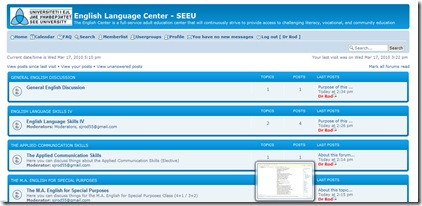
Ardian in Year 2 – Advanced Skills IV class has created the forum listed below for discussion of events in class as well as various other topics. I encourage all my SEE University students to sign on and actively participate – you never know – it might get you extra credit!
http://enforum.justgoo.com/forum.htm

Faculty of Teacher Training - English Department
Course Title: English for Specific Purposes – 2010 - M.A. ELT Program (4+1 / 3+2)
Instructor: Dr. Rod
E-mail: sjrod55@gmail.com
*The instructor reserves the right to change the syllabus as the course progresses if necessary
Course Overview and Objectives:
English for Specific Purposes (ESP) is known as a learner-centered approach to teaching English as a foreign or second language. It meets the needs of adult learners who need to learn a foreign language for use in their specific fields, such as science, technology, medicine, leisure, and academic learning. This course is recommended for graduate students and foreign and second language professionals who wish to learn how to design ESP courses and programs in an area of specialization such as English for business, Engineering, and for Academic Purposes. In addition, they are introduced to ESP instructional strategies, materials adaptation and development, and evaluation.
Its objectives include:
Knowledge and Understanding:
Learning Outcomes
A1 : Knowledge of key principles involving the historical development and existing practice in ESP
A2 : A detailed acquaintance of genres spanning written/spoken discourse and a variety of specialised contexts (academic and non-academic) in which English is taught and used
A3 : An appreciation of the strategies employed by ESP learners in different disciplines and of the roles of ESP teachers
A4 : An understanding of how the above apply to particular teaching situations, especially those that the student is familiar with, in the context of accepted contemporary professional practice
Teaching Methods
1-4 are taught initially through staff-led modules, using a variety of means of delivery (formal lecture, seminar, question-answer discussion session, group-work task-based session, computer lab session, student oral reports, workshop). 4 is enhanced by classroom observation where possible. Staff feedback to students on coursework is a connected important feature enhancing learning. Learning is expected to be deepened through directed and independent self-access library study and use of web material both put up by staff and generally available on the internet.
Intellectual / Cognitive Skills:
Learning Outcomes
B1 : Critical skills needed to evaluate disparate sources of information, both academic (e.g. lectures, books) and experiential, and collate, select, and apply the information to a specific teaching issue or situation critical skills needed to evaluate disparate sources of information, both academic (e.g. lectures, books) and experiential, and collate, select, and apply the information to a specific teaching issue or situation
B2 : An ability to formulate coherent and logically sound arguments
B3 : Ability to reflect independently on own teaching/learning experience and relate it to the ideas and research in the field
B4 : Ability to identify a research question or hypothesis, choose appropriate research methods, and interpret own and others' data and see the implications for a hypothesis or question
Teaching Methods
1-4 are fostered repeatedly by all the means of teaching/learning described in (A)
Practical Skills:
Learning Outcomes
C1 : Ability to seek and retrieve relevant information from a variety of sources (e.g. library, journals, WWW)
C2 : Ability to communicate lucidly in speech and writing about theoretical matters, teaching and learning issues and own teaching experience, in appropriate style
C3 : Practical skills in analysing the core properties of syllabuses and materials in different language learning/teaching situations
C4 : Ability to propose, plan, execute and write up an original, complete but limited study related to ESP with due treatment of appropriate prior research and theory, generation of research aims, application of relevant methods (e.g. empirical data gathering, or syllabus/materials design or evaluation) and management and presentation of the whole project with due attention to proper professional practice and ethics.
Teaching Methods
1 is promoted by staff guidance as well as being guided by staff teaching, and giving advice
2 is promoted by the oral and written tasks associated with the taught modules, and feedback on them, and by guidance in course booklet and an unassessed module on assignment and dissertation writing
3 is dealt with by embedding practical data analysis tasks into specialist modules.
4 is promoted by supervision of the obligatory dissertation
1-4 are further supported by advice from me in consultation hours or by email, and by web-based self-access material.
Key Skills:
Learning Outcomes
D1 : a. Oral participation in group discussion and lectures b. Academic writing, both in the form of argumentative academic papers and research reports, in appropriate style c. Critical reading: researching and utilising information, including scanning, recognising opinion and bias, detecting relevant points, collating different sources.
D2 : Using advanced computational tools and software packages to obtain, store and process information stored in electronic form (e.g. from the Library, WWW or CD-rom).
D3 : a. Analysis of tasks and identification of objectives b. Identification and use of relevant information sources c. Establishing main features of a complex problem d. Planning and selection of approach to reach a solution
D4 : Participation in pair/group class tasks (including organising and evaluating own and others' contributions)
D5 : a. Use of independent time management skills, initiative, and different approaches to working autonomously to meet assignment and dissertation targets b. Use of feedback and support from peers, lecturers and supervisor to meet targets and improve over the year
Teaching Methods
1 and 5 are promoted by many taught modules, and involve listening and note taking in lectures. They are also facilitated by feedback.
2 is promoted mainly by self access material on WWW. More generically, students will be expected to become familiar with basic PC management and the word processing of academic documents, internet searching, etc. in connection with their work for all modules.
4 and 6 are promoted via the assignments which impose requirements for students to apply these skills
1-2 and 4-6 are all further practised for the dissertation, and aided when necessary by staff advice by email or consultation
Attendance policy:
In accordance with the university’s attendance policy, students must attend 70% of the meetings in order to be able to pass the course. If a student misses more than 30 % of the classes, the student will automatically fail the course, regardless of performance on the assignments. The dismissal of excused absences (medical appointments, family emergencies, etc.) will be taken up on a case by case basis.
Academic Dishonesty
An incident of academic dishonesty occurs when a student commits any of the following acts (this list does not preclude other acts of academic fraud):
1. Cheating refers to the use or attempted use of unauthorized materials, information, or study aids in an academic exercise or assignment.
2. Fabrication refers to the unauthorized falsification or invention of any information or citation in an academic exercise.
3. Facilitating academic dishonesty is the act of helping or attempting to help another to violate any provision of the institutional policy on academic dishonesty.
4. Plagiarism describes the unacknowledged adoption or reproduction of the ideas, words, statements of another person, including classroom peers.
Students caught engaging in academic dishonesty once will fail the assignment. Two or more incidents of academic dishonesty will result in failure of the course.
Assessment:
| Grade Scale | Grade Description | Grade Points |
| 95% - 100% | Excellent | 10.0 |
| 86% - 94% | Very good | 9.0 |
| 77% - 85% | Good | 8.0 |
| 68% - 76% | Satisfactory | 7.0 |
| 60% - 67% | Passing | 6.0 |
Assessment in this course will be continuous (ongoing). Students therefore should be advised that each and every meeting is crucial to their success in the course. The students will be assessed for these components:
Please be well aware that while there will not be formalized mid and final year examinations, the continuous assessments, in total, have the same effect and weigh equally.
Grading Rubric:
| Attendance | 10 % |
| Homework | 20 % |
| Participation | 20 % |
| Debate | 10 % |
| Writing assignments | 40 % |
| Total | 100 % |
Course Outline:
| Session 1
|
|
| Session 2
|
|
| Session 3 | Discussing issues related to the design of needs analysis tools for your specific group of learners Assignment 1: Design a needs analysis plan for your target population that you would carry out if you had sufficient time and money. |
| Session 4 |
Assignment 2: Find written or spoken texts for analysis that are appropriate for your learners and conduct genre analysis |
| Session 5 | Discussing how the results of your needs analysis help setting the parameters of your ESP course design. Give and receive feedback. Assignment 3: Propose a course design plan |
| Session 6
|
Assignment 4: Write a reflection paper on selecting materials for your target population |
| Session 7 |
|
Incomplete (IN): An incomplete grade may be assigned if a student has not finished all course requirements by the end of the semester, but has completed a substantial amount of the work. It is the student’s responsibility to bring pertinent information to the teacher and to reach an agreement on how the remaining course requirements will be satisfied. If requirements are not completed within one year, a failing grade is automatically assigned.
Recommended reading:
English for Specific Purposes by Keith Harding –
Oxford University Press 2007.
ISBN – 13: 987 019 442575 9 and ISBN – 10: 0 19 442575 9
Articles:
Basturkmen, H. (1998). Refining procedures: A needs analysis project at Kuwait University. English Teaching Forum, 36(4). Also available at: http://exchanges.state.gov/forum/vols/vol36/no4/p2.htm
Bhatia, V. K. (1997). Applied genre analysis and ESP. In T. Miller (Ed.), Functional approaches to written text: Classroom applications (pp. 134-149). English Language Programs: United States Information Agency. Also available at: http://exchanges.state.gov/education/engteaching/pubs/BR/functionalsec4_10.htm
Bosher, S. & Smalkoski, K. (2002). From needs analysis to curriculum development: Designing a course in health-care communication for immigrant students in the USA. English for Specific Purposes, 21(1): 59-79. (can be accessed online from IU Library website with an IU account)
Douglas, D. (1999) Assessing Languages for Specific Purposes CUP
Dudley-Evans,T and M. St. John (1998) Developments in ESP: a Multi-Disciplinary Approach C UP
Dudley-Evans, T. (2000). Genre analysis: A key to a theory of ESP? Iberica, 2, 3-11. Also available at: www.uv.es/aelfe/WebRAs/RA-2-Dudley.pdf
Hutchinson, T. and A. Waters (1997) English for Specific Purposes, CUP
Johns, A. M. (1991). English for specific purposes (ESP): Its history and contributions. In M. Celce-Murcia (Ed.), Teaching English as a second or foreign language (2nd ed., pp. 67-77). New York: Newbury House.
Johns, A. M., & Price-Machada, D. (2001). English for specific purposes (ESP): Tailoring courses to students' needs-and to the outside world. In M. Celce-Murcia (Ed.), Teaching English as a second or foreign language (3rd ed., pp. 43-54). Boston: Heinle & Heinle.
Mackay , R and A Mountford (Eds) (1978) English for Specific Purposes Longman
McDonough, J. (1984) ESP in Perspective. Collins
Munby, J (1978) Communicative Syllabus Design CUP
Richterich, R (Ed.) (1983) Case Studies in Identifying Language Needs Pergamon
Robinson, P. (1991) ESP: A Practitioner's Guide. Prentice Hall International
Swales, J (1985) Episodes in ESP Pergamon
West, R. (1994). Needs analysis in language teaching. Language Teaching 27(1): 1-19.


![clip_image010[1]](https://blogger.googleusercontent.com/img/b/R29vZ2xl/AVvXsEiX_RIp-sNyjvIH5CcRM1ru8upN703ZG8h7zo3P6UMHURqhhd-Ibb616j_Tj9GlmL8Kr_0B7qhI3-FXj2Z1JGrN6LUwGqwiXgcQ55TCaF4wyczXSGUu5OZpQPkziGDYbPJhuS9i-PGc7wI/s1600-h/clip_image010%5B1%5D%5B2%5D.gif "clip_image010[1]")
![clip_image009[1]](https://blogger.googleusercontent.com/img/b/R29vZ2xl/AVvXsEgMSnYoDnkrA0NFqwr0CRE1QMVY4klapx5DXIQMW_3diqt24UNzWIKGIhC3HLsjZ1rSy7LBSsx-ZQlbj4TkbCL5o2BAONmYSSGs4yGl079JeHqFKxYt0qC7G1xkZFfoNjJShO2imTAan8c/s1600-h/clip_image009%5B1%5D%5B2%5D.gif "clip_image009[1]")
![clip_image004[1]](https://blogger.googleusercontent.com/img/b/R29vZ2xl/AVvXsEhW4ohaPVYmz_uyHsB6YGWm7D13YH7Pz7mYzD6trSV5tMmcjqtcJYRdSclKTOf3tEw-4qPAJYiO2rXPWEQs6KdTRz6MxP0mGPIB7jMN0OQTe9V4Plsn7ulLQwFgfQHovGz2sfIGlhRfCi0/s1600-h/clip_image004%5B1%5D%5B2%5D.gif "clip_image004[1]")
![clip_image005[1]](https://blogger.googleusercontent.com/img/b/R29vZ2xl/AVvXsEj0SP0bX8gjMPDW37f3eosddsk2uyECrYMSN-SVGddV7bS3j8O_b0RGxV5FgvLPAo2sJETOktKmagqrn1aEzdup017GJi-Mcbb4Z3hPp8AyZCvL_G41NPiCXvIhmPhF9T9PvdZh2-XZtEM/s1600-h/clip_image005%5B1%5D%5B2%5D.gif "clip_image005[1]")
![clip_image007[1]](https://blogger.googleusercontent.com/img/b/R29vZ2xl/AVvXsEiTh0LL30ery_nav1Z_EiHZ0GdBBLfpvzjgEFlDDhou9jU9VZiLVExqfpOQ-Ly_aHkVYGPZxdDYYAYgm4OVeXWlCnB2AarbjmzT6EG2drdyKa5lCNHiKelJgJIvWCNCb_-aun3F12Qgbts/s1600-h/clip_image007%5B1%5D%5B2%5D.gif "clip_image007[1]")
![clip_image008[1]](https://blogger.googleusercontent.com/img/b/R29vZ2xl/AVvXsEgT2mTaeFqG7_juWGdl7KWbTF2JrrNhiUflXOvTdbJkjxnhzLcj87LTf3VYvIFRV461aKp75_xovbHo4LbSOrw79vwvqmxT4ViyKo5otlWDhDdFAt9QN0rIWsP6Sr_Dw7X9W7jDUxW54kc/s1600-h/clip_image008%5B1%5D%5B2%5D.gif "clip_image008[1]")
![clip_image006[1]](https://blogger.googleusercontent.com/img/b/R29vZ2xl/AVvXsEhULXkGndhRjGOVumRF5VSL5j0kNeYoBR10And0GZV6YuuPfvxe_6Q7k2oX6QNwcCjmYb9N9bLQPfrtVHEl12Lb2pVjuPGFCtpiNYalIi1m-08UXHHVHJAjWamQn5j6BvcP1fMSEs1Pl2A/s1600-h/clip_image006%5B1%5D%5B2%5D.gif "clip_image006[1]")
![clip_image011[1]](https://blogger.googleusercontent.com/img/b/R29vZ2xl/AVvXsEgc9FUBOta0DCM0CY7A4hccKG670SSvKtx6Gz-Tb2j6-8rdTq5VYiscg7CCWgYB7nW9gnFglHJCcOOrvoPyOYxL0sH8xD6ImVJbfstoqoywEaY7QwwXwrZCuw9l_XF5nZ7slv0KBXhRz14/s1600-h/clip_image011%5B1%5D%5B2%5D.gif "clip_image011[1]")