Showing posts with label Extra Credit. Show all posts

Tuesday, February 1, 2011

International Debate Education Association (IDEA)

Here at SEE University we will be initiating a new Debate Society and Team to be trained to represent SEEU in intern Macedonian University Debate Competitions as well as International events. The International Debate Education Association will be assisting us in creating a new and exciting program for our students.

For more details about IDEA – check out their web site. Here is the basic introduction:


About IDEA

"Freedom is hammered out on the anvil of discussion, dissent, and debate.” - Hubert Humphrey

The International Debate Education Association (IDEA) develops, organizes and promotes debate and debate-related activities in communities throughout the world. Established in 1999 to coordinate pilot debate programs initiated by The Open Society Institute, IDEA acts as an independent membership organization of national debate clubs, associations, programs, and individuals who share a common purpose: to promote mutual understanding and democracy globally by supporting discussion and active citizenship locally.

Fostering the Next Generation of Civic Leadership Throughout the World
Although it maintains an international presence, IDEA places particular emphasis on those societies where democracy is in its infancy and where negotiated resolution to conflicts and cross-community dialogue are little-established concepts. By offering young people the opportunity to debate the important issues facing them, IDEA strives to cultivate and nurture an engaged, democratic citizenry, underscoring the notions of tolerance, international cooperation, and freedom of expression.

A Global Reach with a Local Focus
IDEA promotes its programs and its mission via a wide range of educational and strategic initiatives, from curriculum development and active citizenship training to international student exchanges and an annual, much-celebrated international youth forum. IDEA is registered in the Netherlands and the United States; its debates take place in over 60 languages in over 50 countries throughout the world.

We invite you to explore the IDEA website and learn more about our goals, programs, initiatives, and free educational tools.

Wednesday, March 17, 2010

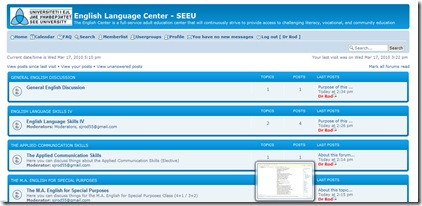
English Forum - Additional Resource

SEEU


Faculty of Teacher Training - English Department

Course Title: Advanced English Language IV

Instructor: Dr. Rod

Ardian in Year 2 – Advanced Skills IV class has created the forum listed below for discussion of events in class as well as various other topics. I encourage all my SEE University students to sign on and actively participate – you never know – it might get you extra credit!

http://enforum.justgoo.com/forum.htm

English Forum

Sunday, August 16, 2009

Related Lord of the Flies Resources


Related Links on Lord of the Flies

Summary and Map - A well-designed website that includes a quick overview of the themes and a brief summary of the novel. The map is an artistic rendering of the island.

Nobel Prize Official Website - A biography of William Golding and a transcript of his entire Nobel lecture.

Nobel Prize in Literature: Lord of the Flies - A Lord of the Flies adventure game that requires you to use your knowledge of the novel to complete the challenges.

Lord of the Flies Adventure Maze - A text adventure game you can play, based closely on the novel.

Lord of the Flies: Vocabulary - A game designed to test your knowledge of the vocabulary used in the novel.

Related Content for Lord of the Flies

Study Guide for Lord of the Flies

Lord of the Flies Quiz …. how well can you do now?

Quiz

1. Whose responsibility is it to maintain the first signal fire?

(A) Piggy’s

(B) The hunters’

(C) Sam and Eric’s

(D) The littluns’

2. What powers does Jack ascribe to the beast after Simon’s murder?

(A) Immortality and the power to change shape

(B) Telepathy and the power to change shape

(C) Immortality and telepathy

(D) Enormous strength and murderous cunning

3. How does the first boy disappear?

(A) Roger crushes him with a boulder.

(B) The other boys kill him with their bare hands.

(C) A boar gores him.

(D) He burns to death when the signal fire ignites the forest.

4. Who is the first boy to disappear?

(A) Piggy

(B) Simon

(C) Clark

(D) A littlun

5. Where does the beast go during the day, according to one littlun?

(A) Into the ocean

(B) Into the air

(C) Into the fire

(D) Into the caves near the Castle Rock

6. Who sees the dead parachutist first?

(A) Ralph

(B) Sam and Eric

(C) Jack

(D) Piggy

7. Which character speaks to the Lord of the Flies?

(A) Phil

(B) Ralph

(C) Piggy

(D) Simon

8. What lures the navy ship to the island?

(A) The fire in the jungle

(B) The roar of the beast

(C) The signal fire

(D) The shortwave radio

9. Whom does Jack strike shortly after his first kill?

(A) Ralph

(B) Francis

(C) Piggy

(D) Roger

10. When Piggy is killed, what else is destroyed?

(A) The shortwave radio

(B) The conch shell

(C) The Lord of the Flies

(D) The signal fire

11. What is Ralph’s first act upon being elected leader?

(A) Planning the building of the signal fire

(B) Naming Piggy his chief advisor

(C) Naming Simon the leader of the mystics

(D) Naming Jack the leader of the hunters

12. What object does Ralph clutch when he talks about Simon’s murder?

(A) The sow’s head

(B) The conch shell

(C) Piggy’s glasses

(D) A spear

13. Who is the only boy to kill someone on the island by himself?

(A) Piggy

(B) Jack

(C) Roger

(D) Robert

14. What does Jack suggest the boys use as the “pig” in their dance-like reenactment of the hunt?

(A) A littlun

(B) Piggy

(C) Ralph

(D) A real pig

15. Which boy treats the littluns with the most kindness?

(A) Simon

(B) Jack

(C) Piggy

(D) Ralph

16. Which boy would rather hunt than build huts?

(A) Simon

(B) Jack

(C) Piggy

(D) Ralph

17. Where is Jack’s tribe headquarters?

(A) Next to Ralph’s

(B) On the mountain of the beast

(C) Deep in the jungle

(D) At the Castle Rock

18. What tool or tools do the boys use to make fire?

(A) A flint and steel

(B) Ralph’s tinderbox

(C) Piggy’s glasses

(D) Matches from the airplane

19. What is the boys’ home country?

(A) England

(B) Australia

(C) New Zealand

(D) Canada

20. Who kills Piggy?

(A) Ralph

(B) Roger

(C) Sam and Eric

(D) Simon

21. What surrounds Simon’s body as it floats into the sea?

(A) Sharks

(B) Eels

(C) A cloud of blood

(D) Glowing fish

22. Who knocks the Lord of the Flies to the ground?

(A) Ralph

(B) Roger

(C) Simon

(D) Piggy

23. On what obstruction does the dead parachutist become tangled?

(A) Tree limbs

(B) Jagged rocks

(C) The roof of the hut

(D) The Castle Rock

24. Who tells Jack where Ralph is hiding in Chapter 12?

(A) Simon

(B) Roger

(C) A littlun

(D) Sam and Eric

25. Which boy does not dance at Jack’s first feast?

(A) Simon

(B) Ralph

(C) Piggy

(D) Jack

Tuesday, April 15, 2008

New Words from our Pronunciation poem.

Atena in 9B spent two nights identifying the new vocabulary words from the first 130 lines of our English pronunciation poem. Here are the ones she identified and their meanings:

Corpse

a dead body, usually of a human being.

Corps

a group of persons associated or acting together

Queer

strange or odd from a conventional viewpoint; unusually different; singular

Seer

a person who sees; observer.

Retain

to keep possession of

Plaid

any fabric woven of differently coloured yarns in a cross barred pattern

Plague

an epidemic disease that causes high mortality; pestilence.

Vague

not clearly or explicitly stated or expressed

Ague

a malarial fever characterized by regularly returning paroxysms, marked by successive cold, hot, and sweating fits.

Gush

to express oneself extravagantly or emotionally; talk effusively:

Bush

a tree branch hung as a sign before a tavern or vintner's shop

Via

by a route that touches or passes through

Fuchsia

a plant belonging to the genus Fuchsia, of the evening primrose family, including many varieties cultivated for their handsome drooping flowers.

oven

A chamber or enclosed compartment for heating, baking, or roasting food, as in a stove, or for firing, baking, hardening, or drying objects, as in a kiln.

Receipt

a written acknowledgment of having received a specified amount of money, goods, etc.

Fraud

deceit, trickery, sharp practice, or breach of confidence, perpetrated for profit or to gain some unfair or dishonest advantage.

Terpsichore

choreography; the art of dancing

Branch

a division or subdivision of the stem or axis of a tree, shrub, or other plant.

Ranch

an establishment maintained for raising livestock under range conditions.

Measles

A disease humans get. Has little red spots on their body.

Aisles

A part of a church divided laterally from the nave by a row of pillars or columns.

Missiles

An object or weapon that is fired, thrown, dropped, or otherwise projected at a target; a projectile.

Reviles

To use abusive language.

Wholly

to the whole amount, extent, etc.

Holly

the foliage and berries, used for decoration, esp. during the Christmas season.

Vicar

a person acting as priest of a parish in place of the rector, or as representative of a religious community to which tithes belong.

Mica

any of various minerals consisting of hydrous silicates of aluminium or potassium etc. that crystallize in forms that allow perfect cleavage into very thin leaves; used as dielectrics because of their resistance to electricity

Plumber

a person who installs and repairs piping, fixtures, appliances, and appurtenances in connection with the water supply, drainage systems, etc., both in and out of buildings.

Lumber

timber sawed or split into planks, boards, etc.

Brier

a prickly plant or shrub, esp. the sweetbrier or a greenbrier.

Brougham

an early type of automobile resembling a coupé, often powered by an electric motor.

Anemone

A sea animal usually with poisonous spines

Laundry

articles of clothing, linens, etc., that have been or are to be washed.

Laurel

any of various similar trees or shrubs, as the mountain laurel or the great rhododendron.

Tortoise

a turtle, esp. a terrestrial turtle.

Turquoise

Also, turquoise. An opaque mineral, a basic hydrous copper aluminium phosphate often containing a small amount of iron, sky-blue or greenish-blue in colour, cut cabochon as a gem.

Gross

large, big, or bulky.

Brook

1 a small or narrow river

2 to bear; suffer; tolerate:

Brooch

a circular stone tower built around the beginning of the Christian era, having an inner and an outer wall, found on the Orkney Islands, Shetland Islands, the Hebrides, and the mainland of Scotland.

Plinth

a slab like member beneath the base of a column or pier.

Endeavoured

A conscientious or concerted effort toward an end; an earnest attempt.

Revered

to regard with respect tinged with awe; venerate

Severed

To become cut or broken apart.

Foul

muddy, as a road.

Soul

the emotional part of human nature; the seat of the feelings or sentiments.

Bouquet

a bunch of flowers;

Wallet

a flat, folding pocketbook, esp. one large enough to hold paper money, credit cards, driver's license, etc., and sometimes having a compartment for coins.

Mallet

A short-handled hammer, usually with a cylindrical head of wood, used chiefly to drive a chisel or wedge.

Chalet

A wooden dwelling with a sloping roof and widely overhanging eaves, common in Switzerland and other Alpine regions.

Flood

great flowing or overflowing of water, esp. over land not usually submerged.

Mould

loose soil rich in organic matter

Banquet

a lavish meal; feast.

Parquet

a floor composed of short strips or blocks of wood forming a pattern, sometimes with inlays of other woods or other materials.

Khaki

dull yellowish brown.

Discount

an amount deducted from the usual list price.

Viscount

a British peer who ranks below an earl and above a baron

Fiend

any evil spirit; demon.

Grieve

To cause to be sorrowful; distress

Sieve

a device used to strain or separate

Keats

British poet

Asserts

To state or express positively

Hugh

a male given name: from a Germanic word meaning “heart, mind.”

Hug

to cling firmly or fondly to; cherish:

Hood

A head covering - usually part of a jacket.

Hoot

the cry of an owl.

Buoyant

To be able to float.

Minute

Very small

Tally

an account or reckoning; a record of debit and credit, of the score of a game, or the like.

Paradigm

A change in mental direction or belief

Tease

something resembling or suggesting such a covering, esp. in shape, as certain petals or sepals.

Crease

a wrinkle, esp. one on the face.

Cease

to come to an end: At last the war has ceased.

Greasy

smeared, covered, or soiled with grease.

Valise

small piece of luggage that can be carried by hand, used to hold clothing, toilet articles, etc.; suitcase; traveling bag.

Cornice

any prominent, continuous, horizontally projecting feature surmounting a wall or other construction, or dividing it horizontally for compositional purposes.

Lullabies

a song used to lull a child to sleep; cradlesong.

Nauseous

1 To feel sick

2 disgusting; loathsome: a nauseous display of greed.

Cautious

Showing or practicing caution; careful.

Tortious

of the nature of or pertaining to a tort.

Envelop

to surround entirely.

Affidavit

written declaration made under oath; a written statement sworn to be true before someone legally authorized to administer an oath

Davit

any of various crane like devices used singly or in pairs for supporting, raising, and lowering esp. boats, anchors, and cargo over a hatchway or side of a ship.

Tow

something, as a boat or truck, that tows.

Rachel

In the Bible, the second wife of Jacob and the mother of Joseph and Benjamin.

Loch

1. a lake.

2. a partially landlocked or protected bay; a narrow arm of the sea.

Moreover

in addition to what has been said; further; besides.

Mover

a person or thing that moves.

Plover

any of various similar shorebirds, as the upland plover and other sandpipers.

Leeches

One that preys on or clings to another; a parasite.

Breeches

The lower rear portion of the human trunk; the buttocks.

Lice

any insect of the order Mallophaga (bird louse, biting louse, or chewing louse), parasitic on birds and mammals, having mouthparts adapted for biting

Constable

an officer of the peace, having police and minor judicial functions, usually in a small town, rural district, etc.

Plait

pleat or fold, as of cloth.

Ruin

destroyed or decayed building, town, etc.

Conduit

a pipe, tube, or the like, for conveying water or other fluid.

Circuit

an act or instance of going or moving around.

Timber

growing trees themselves.

Bullion

gold or silver considered in mass rather than in value.

Chaise

the chief executive official, usually elected, of a city, village, or town.

Mayon

a light, open carriage, usually with a hood, esp. a one-horse, two-wheeled carriage for two persons; shay.

Ivy

any of various other climbing or trailing plants.

Privy

private; assigned to private uses.

Clamour

a loud uproar, as from a crowd of people: the clamour of the crowd at the gates.

Drachm

a unit of apothecary weight equal to an eighth of an ounce or to 60 grains

Posses

A group of people summoned by a sheriff to aid in law enforcement.

Pussy

A cat - Puss in Boots, Pussy Cat

Hussy

a brazen or immoral woman.

Countenance

appearance, esp. the look or expression of the face: a sad countenance.

Lieutenants

One who holds the rank of lieutenant, first lieutenant, or second lieutenant.

Hoist

an apparatus for hoisting, as a block and tackle, a derrick, or a crane.

Lieu

in place of; instead of

Flags

to mark (a page in a book, file card, etc.) for attention, as by attaching protruding tabs.

Pennants

A flag or an emblem similar in shape to a ship's pennant.

Courier

a messenger, usually traveling in haste, bearing urgent news, important reports or packages, diplomatic messages, etc.

Courtier

a person who is often in attendance at the court of a king or other royal personage.

Solder

Any of various fusible alloys, usually tin and lead, used to join metallic parts.

Quoth

Uttered; said. Used only in the first and third persons, with the subject following: "Quoth the Raven,

Bravado

Pretending to be grave

Ado

flurry; confusion, upset, excitement

Devour

to swallow or eat up hungrily, voraciously, or ravenously.

Clangour

1. a loud, resonant sound; clang.

2. clamorous noise.

Grand

impressive in size, appearance, or general effect: grand mountain scenery.

Scenic

of or pertaining to natural scenery.

Gooseberry

Any of several plants bearing similar fruit.

Goose

to give a spurt of fuel to (a motor) to increase speed.

Dose

Small amount of something - usually medicine

Inveigh

To give vent to angry disapproval; protest vehemently.

Neigh

the cry of a horse; whinny.

Inveigle

to acquire, win, or obtain by beguiling talk or methods (usually fol. by from or away): to inveigle a theater pass from a person.

Bet

An amount or object risked in a wager; a stake.

Mani

Persian prophet and founder of Manichaeism. His religious movement, a rival to early Christianity, professed that the world is a fusion of the equal but opposite forces of good and evil.

Rapier

a small sword, esp. of the 18th century, having a narrow blade and used for thrusting.

Pir

a religious instructor, esp. in mystical sects.

Tier

one of a number of galleries, as in a theater.

Ties

unusualness; the state or condition of being unusual.

Erring

going astray; in error; wrong.

Herring

commercially important food fish of northern waters of both Atlantic and Pacific

Stirring

moving, active, bustling, or lively: a stirring business.

Bison

A bovine mammal (Bison bison) of western North America, having large forequarters, a shaggy mane, and a massive head with short curved horns; a buffalo.

Trove

a collection of objects.

Hover

to keep lingering about; wait near at hand.

Cove

a sheltered nook.

Perseverance

steady persistence in a course of action, a purpose, a state, etc., esp. in spite of difficulties, obstacles, or discouragement.

Severance

a breaking off, as of a friendship.

Piebald

having patches of black and white or of other colors; parti-coloured.

Nibbled

to bite off small bits.

Phaeton

any of various light, four-wheeled carriages, with or without a top, having one or two seats facing forward, used in the 19th century

Paean

any song of praise, joy, or triumph.

Gnat

Any of various small, biting, two-winged flies, such as a punkie or black fly.

Ghat

a mountain pass.

Lien

The right to take and hold or sell the property of a debtor as security or payment for a debt or duty.

Buffet

to strike, as with the hand or fist.

Rook

a large black bird

Boon

something to be thankful for; blessing; benefit.

Worcester

a city in central Massachusetts.

Boleyn

Queen of England (1533-1536) as the second wife of Henry VIII. The mother of Elizabeth I, she produced no male heir and was subsequently tried for adultery and beheaded.

Impugn

to challenge as false (another's statements, motives, etc.); cast doubt upon.

Sterling

Also called sterling silver. silver having a fineness of 0.925, now used esp. in the manufacture of table utensils, jewelry, etc.

Hearse`

A carriage specially adapted or used for conveying the dead to the grave.

Hearken

to listen to; hear

Yearling

Horse one year old

Mezzotint

a method of engraving on copper or steel by burnishing or scraping away a uniformly roughened surface.

Pores

To gaze intently; stare.

Pours

To make (a liquid or granular solid) stream or flow, as from a container.

Paws

To strike or scrape with a beating motion: The bull pawed the ground before charging.

Maiden

a girl or young unmarried woman; maid.

Coy

shy; modest.

Comely

Help people

Fraud

a particular instance of such deceit or trickery: mail fraud; election frauds.

Trivial

commonplace; ordinary.

Vial

to put into or keep in a vial.

Tripod

a stool, table, pedestal, etc., with three legs.

Trolley

a pulley or truck traveling on an overhead track and serving to support and move a suspended object.

Realm

a royal domain; kingdom: the realm of England.

Ream

to cheat; defraud.

Schedule`

a list or statement of supplementary details appended to another document b : a formal list, table, catalogs, or inventory

Mischief

conduct or activity that playfully causes petty annoyance.

Schism

division or disunion, esp. into mutually opposed parties.

Argil

Clay, especially a white clay used by potters.

Gill

the respiratory organ of aquatic animals, as fish, that breathe oxygen dissolved in water.

Piquet

a card game played by two persons with a pack of 32 cards, the cards from deuces to sixes being excluded.

Sobriquet

An affectionate or humorous nickname.

Pallid

any lover.

Uncouth

unusual or strange.

Paramour

any lover.

Enamoured

delighted with

Example: I am not enamoured of the idea of going abroad.

Flighty

slightly delirious; light-headed; mildly crazy.

Antipodes

a group of islands SE of and belonging to New Zealand. 24 sq. mi. (62 sq. km).

Obsequies

a funeral rite or ceremony.

Razor

an electrically powered instrument used for the same purpose.

Conquer

to gain, win, or obtain by effort, personal appeal, etc.: conquer the hearts of his audience.

Conquest

the winning of favour, affection, love, etc.: the conquest of Antony by Cleopatra.

Phase

anything resembling such an implement, as the tail of a bird.

Fan

anything resembling such an implement, as the tail of a bird.

Pious

having or showing a dutiful spirit of reverence for God or an earnest wish to fulfil religious obligations.

Impious

1. not pious or religious; lacking reverence for God, religious practices, etc.; irreligious; ungodly.

2. disrespectful.

Limb

a large or main branch of a tree.

Glumly

Moody and melancholy; dejected.

Gloomy; dismal.

Crumbly

apt to crumble; friable.

Dumbly

lacking intelligence or good judgment; stupid; dull-witted.

Anxiety

earnest but tense desire; eagerness: He had a keen anxiety to succeed in his work.

Archaic

marked by the characteristics of an earlier period; antiquated: an archaic manner; an archaic notion

Albeit

although; even if: a peaceful, albeit brief retirement.

Very helpful Atena. Thank you for the extra work.

Sunday, March 30, 2008

Alba H ~ Extra Credit Super Star

Regrets

Growing up is not an easy thing to do, especially when you’re a teenager! Your hormones drive you crazy and you can’t stop them. Almost everybody regrets something from their past. No one is perfect, so everyone really does shave something to regret. They wish that they could just go back for one second and change it all. Even if that were possible, they would soon find something else to regret! For the moment, I only regret one thing, not enjoying every moment of everyday! Seeing as I am only a teenager, I still haven’t done anything big with my life. Actually, I regret not having regrets!

You only live once, but still I don’t act like it. The reason for this is that I am so young and I feel like I have my whole life ahead of me. The reality is that life is short and it could be stopped at any time. It’s not up to us to decide when our time is up and it’s not up to no “God” either. It’s all up to luck and fait. That’s why good things happen to bad people and bad things happen to good people. To make it short, whatever happens happens and there is no way to stop it! So the only thing you can do is live life till the end but the type of person you want to be is all up to you, or is it?

Depending on what kind of parents you had, you will be either good or bad! Believe it or not you will end up being just like your parents because hats how you were raised to be. Sometimes this isn’t very good for some people because not all parents are good at their job. Some parents know that their children are bound to have mistakes or rebel, especially as a teenager. The only difference is that these parents accept their kids for who they are and don’t try to change them. People, especially teens need to find out for themselves what their mistakes are. Instead of doing this, some religious families, try to create rules that can’t be broken. This keeps their child from flourishing on their own.

It’s usually these kids that end up regretting a lot. This is because they were not able to live their life the way they wanted. They never got to try anything new. They never got to rebel. Unfortunately, I am one of these people. I can tell you myself that being under that type of control isn’t so fun. It’s not like these parents want me to not live life. I know that the only reason they do this is so that I don’t become a bad adult. At the end of the day, they want to be able to say, we have a great daughter. The only problem is that they don’t allow big mistakes. Why is that a problem? Well, you need these big mistakes to teach yourself about yourself, in fact. Every decision you make really does affect you, whether good or bad.

So, being a teenager is not easy. It may feel like you got so much to see and so much to do but it could all be over so soon! It only takes one drop of water for you to drown. It only takes one step to fall off a cliff. The only thing that you can do is be yourself. Take into consideration what your parents say because they truly are wise then you. Never ever forget that life is all up to you and in the end it’s not the regrets that mater. Think about all the laughs, friends, and love you’ve had in your life. Those matter the most. Therefore, take a couple steps outside yourself and live life to the fullest, taking the best path for yourself. I’m sure at the end of it all, lying in your grave; you won’t regret a single thing and with a smile on your face, walk to the other side, whatever it maybe!


Excellent essay Alba ~ well done. You have brought together your emotions, feelings and expressed them for us all to share! Great work.

Wednesday, March 26, 2008

Merchant of Venice REVIEW materials

Literature Unit

The Merchant of Venice
by William Shakespeare(Grades 8-11)

Book Report Form
The Merchant of Venice book report form (PDF File)
Customize the The Merchant of Venice book report

Mixed Review Literature Unit
The Merchant of Venice mixed review - print all section questions at once (options for multiple keys)

Extended Activities
Extended Activities

Word Wall
The Merchant of Venice Word Wall

Act 1 Review
Quiz and writing prompts (PDF File)
Edit the quiz questions and vocabulary using edHelper's quiz tool
Vocabulary
Spelling and vocabulary review (options for multiple keys and pages per key)
Crossword Puzzle (PDF and options)
Word Search (PDF and options)
Crossword Puzzle (HTML)
Word Search (HTML)
Circle the Correct Word
Build Words
Fill in the Missing Letter
Unscramble the Words
Vocabulary Quiz (PDF)

Act 2 Review
Quiz and writing prompts (PDF File)
Edit the quiz questions and vocabulary using edHelper's quiz tool
Vocabulary
Spelling and vocabulary review (options for multiple keys and pages per key)
Crossword Puzzle (PDF and options)
Word Search (PDF and options)
Crossword Puzzle (HTML)
Word Search (HTML)
Circle the Correct Word
Build Words
Fill in the Missing Letter
Unscramble the Words
Vocabulary Quiz (PDF)

Act 3 Review
Quiz and writing prompts (PDF File)
Edit the quiz questions and vocabulary using edHelper's quiz tool

Vocabulary
Spelling and vocabulary review (options for multiple keys and pages per key)
Crossword Puzzle (PDF and options)
Word Search (PDF and options)
Crossword Puzzle (HTML)
Word Search (HTML)
Circle the Correct Word
Build Words
Fill in the Missing Letter
Unscramble the Words
Vocabulary Quiz (PDF)

Act 4 Review
Quiz and writing prompts (PDF File)
Edit the quiz questions and vocabulary using edHelper's quiz tool

Vocabulary
Spelling and vocabulary review (options for multiple keys and pages per key)
Crossword Puzzle (PDF and options)
Word Search (PDF and options)
Crossword Puzzle (HTML)
Word Search (HTML)
Circle the Correct Word
Build Words
Fill in the Missing Letter
Unscramble the Words
Vocabulary Quiz (PDF)

Act 5
Quiz and writing prompts (PDF File)
Edit the quiz questions and vocabulary using edHelper's quiz tool

Final Review Quiz (PDF File)
Final Review Quiz
Edit the quiz questions and vocabulary using edHelper's quiz tool

Vocabulary
Crossword Puzzle (PDF and options)
Word Search (PDF and options)
Crossword Puzzle (HTML)
Word Search (HTML)
Circle the Correct Word
Build Words
Fill in the Missing Letter
Unscramble the Words
Vocabulary Quiz (PDF)

Merchant of Venice: Advanced Questions


Year 11 Students ...


Your mission, if you choose to accept it, is to find the University library. And, once you've found it, to find the computers and CD-ROMS available within. First, go to BIBSYS and get on-line. Find one secondary source for Shakespeare's Merchant of Venice. Then, find out the MLA CD-ROM and find one article on Shakespeare's Merchant of Venice. This is not a 'formal' assignment, but it might be good practice for those of you going on for hovedfag. Let me know what you find!


1. How are the marriage and trial plots similar? Can they be paralelled? Explain.

2. How can characters like Antonio and Bassanio, Salerio and Solanio, etc., claim that love and money are compatible? In any case, why do they do so throughout the text?


3.
...to you Antonio
I owe the most in money and in love,
And from your
love I have a warranty
To unburthen all my plots and purposes
How to get
clear of all the debts I owe.
....
Oh my Antonio, had I but the means
To hold a rival place with one of them,
I have a mind presages me such
thrift
That I should questionless be fortunate.
(I.ii.130-34,
173-76)


Do a close-reading of these lines and then relate it to a theme in the play as a whole. How are these lines symptomatic of attitudes within the play and of this character in particular?


4. How is xenophobia expressed in this play and how is the problem eventually resolved? Is the characterization of Shylock a demonstration of anti-semitism, per se, or of xenophobia more generally?

5. Why is the idea of mercy so important in this text? Who is it most important to and why? (Notice, in particular, who talks about it most.)

6. Is Jessica a 'good' character? That is, do you think she is commendable or reprehensible. Why?

7. Why do the women, Nerissa and Portia, play the ring trick at the end of the play? What is their purpose and what do they achieve?

8.
Ho no, no, no, no: my meaning in saying he is a good man, is to have you
understand me that he is sufficient,--yet his means are in supposition: he hath
an argosy bound to Tripolis, another to the Indies, I understand moreover upon
the Rialto, he hath a third at Mexico, a fourth for England, and other ventures
he hath squand'red abroad,--but ships are but boards, sailors but men, there be
land-rats, and water-rats, water- thieves, and land-thieves, (I mean pirates),
and then there is the peril of waters, winds, and rocks: the man is
notwithstanding sufficient,--three thousand ducats,--I think I may take his
bond. ....
I will be assur'd I may: and that I may be assured, I
will
bethink me... (I.iii.13-24, 26-27)

Do a close reading of this passage and then relate it to a theme we have discussed in class. Again, think about its location in the play and who is speaking.


9. What is the difference between Jewish fiscalism and Christian mercantilism? Talk about how these two ideals are set up in the text and how they are worked out through the ending. (You might also address this as a social class as well as religious issue.)

10. How is music used in this play? It comes up on several occassions: most notably, when Bassanio is choosing his casket and in the final scene at Belmont. Why?

Monday, March 24, 2008

Year 11 Extra Credit - March

Year 11 Guide:

You can get extra credit at any time by writing a paper about any topic we discuss in class, or about any subject or piece of literature that we address in class. The papers must be typed, double-spaced, and in 12 point font. All extra-credit projects must show evidence of hard work and extra effort. You must see me before starting any extra-credit assignment.

You can and should be extra creative about your extra-credit projects as well. You can, for instance:

  1. Write a persuasive essay that attempts to get someone else to try an activity that you are passionate about.
  2. Tie in other subjects, creating a project that connects what you are doing in other classes w.ith what we have been doing (be creative!).
  3. Paint or draw a picture or comic strip about the literary work we are studying, or about something that interested you in class.
  4. Write a small play and produce it for the class.
  5. Write a song or poem about something we do in class.
  6. Create a speech about any subject you are passionate about and deliver it to the class.
  7. Develop a dance routine (maybe a Yoruba dance?) that relates to what we are studying.
  8. Write a letter that may have been passed between literary characters.
  9. Write a movie, book, or album review that could appear in a local newspaper or magazine.
  10. Do anything else that you feel is creative and relates to English in an interesting way. This opportunity is an open canvas on which you can create your very own masterpieces.

OUTSTANDING HW ASSIGNMENT:


Write a standard 8-sentence "body" paragraph that answers this question:

"What is the greatest musical act in history?"

("Musical act" can include: rock band, singer, rapper, rap group, boy band, etc...)

PLEASE:

Type your paragraph, double spaced
Use our standard GRAPHIC ORGANIZER to format sentences correctly
Edit your paragraphs using our 5 mechanical rules handout

Year 9 Extra Credit - March

Extra Credit for Year 9 ONLY

Over the last 7 months we have devoted a lot of time to discussing several short stories and various movies, and during that time we have examined the difficulties faced by several of the characters in those stories. In several instances, those difficulties are caused by poor decisions made by the main character. It is something we can all relate to.

Your extra credit assignment, then, is to examine a decision from your own life which you regret. Read the following prompt and write a well-formed, thoughtful essay.

Each person has been in trouble at one time or another because he or she did something bad or said something wrong. Write a multi-paragraph essay describing an instance when you did something wrong you later regretted and the lesson you learned in the process.

Before writing, you should:

  1. brainstorm your thoughts or create an idea web
  2. Select a topic worthy of writing about
  3. Sketch out a rough organization for your essay

The essay is due April. 1st

To complete this writing assignment, open up a Microsoft Word document and write it there. You will hand in an electronic copy of the assignment.

Year 10 Extra Credit - March

After reviewing your essays, I've noticed several comma and other punctuation problems. One way to improve in this area is through repetition and quizzing on the skills. Below are three online quizzes that will test your knowledge in the use of commas and punctuations.

This next week, complete all three and print the screen after you do it, so I know you completed it.

Each quiz carries Extra Credit Points! (Year 10 ONLY)

Monday, March 10, 2008

Study Questions for Macbeth

    1. Why does this play need Act 1, scene 1?

    • Why does it begin with the 3 witches alone on stage?
    • What is the image of womanhood presented by them?
    • Note Banquo's description of them as looking rather masculine in 1, 3. Why this odd description?

    2. In 1, 5, Lady Macbeth sums up the conditions that would make her able to murder Duncan.

    • What does she need to be like to do this?
    • How does this relate her to the witches?

    3. Act One tells us much about the kingdom under Duncan.

    • What has his reign been like recently?
    • How does the plot of the Macbeths fit into the recent history of Scotland under Duncan?
    • Why is this important to consider?
    • How does Shakespeare present the history and behaviour of the Scots with regard to their kings throughout this play?

    4. Consider the differences throughout the first half of the play between how Macbeth and Banquo handle the information given them by the witches.

    • What does a sensible Scottish thane do when confronted by witches at random?

    5. Look at all the references to "nature" and "unnatural" throughout this play.

    • Why are they vital to the plot?
    • How does this theme reflect upon the actions of the Macbeths?
    • Upon the ultimate crisis of Birnam Wood relocating itself to Dunsinane?
    • Symbolically, what does it mean that the forest gets up and moves once Macbeth has become king?
    • To put it another way, what kind of world is it when trees can just get up and walk around?

    6. In 4,1, three apparitions visit the witches and Macbeth.

    • What does each represent?
    • How do we as audience respond to them?
    • How are we as audience implicated in this plot?
    • Do we believe in the witches as much as Macbeth does?
    • Are there any significant differences here?

    7. Look at the play's geographical center in Act 3; this is often where the author summarizes the major themes of his play through a series of "central" actions.

    • What are the major events of this act?
    • What do they tell us about the themes of the overall play?

    8. So how does Macbeth like being king?

    • What kind of king is he?
    • What is his reign like, other than brief?
    • How does he compare to Duncan as king?
    • How do the rebellions under his reign compare to those under Duncan?

    9. What are the effects of conspiring to murder upon Lady Macbeth?

    • How does she compare to the other women of the play, including
      • the witches
      • Lady Macduff
      • and Macbeth's mother?
    • What is a good noblewoman like in this world?

    10. In 1,7, Macbeth suggests to his wife to "bring forth men-children only" because she is so fierce.

    • Is this a good world to bring forth children in?
    • What happens to kids in this world?
    • Consider all the children in this play, including the ones that seem to have reached adulthood with their fathers still alive. What are their fates?
    • What happens to kids when Macbeth is king?
    • When Duncan is king?
    • What do these situations tell us about the worlds these respective kings create for their subjects?

    11. Why does Banquo's ghost appear at a banquet?

    • What does a banquet symbolize in general?
    • What does a banquet thrown by a king suggest?

    12. How do the Macbeths die?

      What do their forms of death symbolize?

Thanks to JM Massi, Ph.D. for writing these study questions.

Tuesday, March 4, 2008

Merchant of Venice Quiz

Extra Credit Quiz - Year 11

* How many ducats does Antonio borrow from Shylock?
* Antonio realizes he can't pay back the loan. What does Shylock demand of him?
* Of the following, what metal was actually used as one of the 3 caskets?
* What is the name of Shylock's rebellious daughter?
* In the 1973 movie version, who plays Shylock?
* By the end of the play, which of the following characters was not married or engaged to be married?
* What did Jessica receive in exchange for a sapphire that she stole from Shylock?
* What was the pseudonym that Portia used to be Antonio's lawyer?
* Which character speaks the last line of the play?
* Which of the following is not one of Portia's servants?
* Who is 'the merchant of Venice'?
* In what year was 'The Merchant of Venice' first performed?
* What was the name of Old Gobbo's wife and Lancelot Gobbo's mother?
* Where did Jessica spend fourscore (80) ducats in one sitting?
* What does Shylock dream of that makes him suspicious of going out to dinner ?
* Which two men are trying to find out the reason for Antonio's sadness in the first scene of the play?
* Which "part" in the world does Gratiano say he wants to play?
* Which childhood activity does Bassanio talk about when justifying how he wants to spend more money in pursuit of Portia's wealth?
* To what does Bassanio compare the Golden Fleece found by Jason?
* Which of the following is not mentioned amongst the list of suitors who have considered and then rejected trying the choice of the caskets to win Portia in marriage?