Showing posts with label Applied Communications. Show all posts

Monday, February 21, 2011

APPLIED COMMUNICATION: Influence of Social Media

Popularity vs. Influence in Blogging and Social Media: What’s the Difference?

By Jennifer Mattern on April 13, 2010

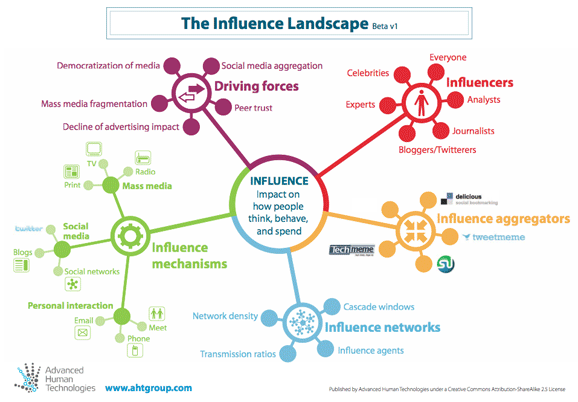
influence

Credit: Advanced Human Technologies (www.ahtgroup.com)

You’ve heard about “influencers” right? That’s a big buzz word especially in the blogosphere these days (and it has been for a couple of years). What exactly is an influential blogger though? Do those lists of the most influential blogs or biggest influencers really mean much?

Honestly, they don’t. Why? Because sadly too many people confuse “influence” with basic popularity. Is there anything wrong with having a popular blog or being a popular personality in your niche or industry? No. Of course not. But being popular doesn’t mean you necessarily have a comparable amount of influence within that niche. Let’s explore both popularity and influence, and talk about why you really need to understand the difference. While we’ll look specifically at bloggers, the same can be true of those on Twitter, social networks, or who are active in any other area of social media.

Defining Popularity and Influence

What does it mean to be a “popular” blogger? It means that people like you (or they like your blog). Specifically related to blogging, it generally means a lot of people like you. You get a lot of traffic and / or a lot of unique visitors. You get a lot of comments. You get the idea….

If you have a lot of traffic, you naturally have a lot of influence, right? Wrong. Influence involves more than numbers. It involves your ability to influence outcomes, actions, and opinions.

The Biggest Difference Between Popularity and Influence

Being treated like a rockstar doesn't always equal influence

Being treated like a rock star doesn't always equal influence - Credit: BigStockPhoto.com

Let’s look at two hypothetical blogs to show why popularity doesn’t necessarily equate to influence. They’re both Internet marketing blogs. Blog A is a relatively high traffic blog — let’s say just under one million page views per month. Blog B gets around 75,000 page views per month instead (still not terrible, but clearly Blog A has them beat).

You could easily argue that Blog A is the more popular blog of the two. Assuming in this case that the larger number of page views comes from a larger number of unique visitors, Blog A has more readers / visitors.

That said, Blog B could still be the more influential blog. Numbers alone don’t cut it. The relationship between the blogger and their audience determines influence much more than traffic stats (or follower stats, or friend counts, etc.).

For example, maybe most of Blog A’s traffic comes from search engines. The visitors are one-time passers-by who only visit the page they land on. They read the content and then they move on. Blog B’s fewer readers are much more invested in the blog. They read regularly. They genuinely care about what the blogger has to say.

If Blogger A told their audience to do something, they might have less influence over their actual actions than Blogger B. The second blogger’s audience might be more likely to do what’s asked of them — think a certain way about a niche issue, try a new tool, take part in a survey, or even buy a product. That’s influence.

Popularity in blogging can leave a lot to chance (or basic search engine optimization). A blogger has to be able to take things a step further if they want to turn that popularity into influence. By all means, a popular blog can be influential. Many are. The mistake is in thinking that one necessarily equals or leads to the other.

Measuring Influence: Can it be Done?

Why do people often rank blogs by “influence” when they’re really only evaluating popularity metrics? Well, “influence” sounds better for starters. Who doesn’t want to feel like they have influence? It’s a power thing, whereas popularity is nice but it’s something tweens and teens are supposed to worry about — not professionals blogging within a given industry.

How do you measure success in social media?

How do you measure success in social media? - Credit: BigStockPhoto.com

Influence sounds better, but popularity is easier to measure. So they get packaged together whether or not it’s completely fair, “right,” or accurate. Is it even possible to measure influence? Personally, I consider it more of a qualitative than quantitative element of blogging and social media, and as such I would have to say it’s difficult, if not impossible, to accurately measure.

A blogger with a relatively small audience might have major pull in the industry because of their network. If they report a problem to a company, it might be fixed in hours or days instead of buried in a mountain of support tickets. If they request a new feature from someone, they might actually get it whereas others would be ignored. They might be able to change the minds of their audience members about an issue that’s important to them. I don’t see how those things can be accurately or fairly measured. Would action #1 get more weight than action #2? How many minds do you have to change to be “influential?”

Sure, we can measure some elements of influence — how many readers were converted into customers, the number of survey respondents, donations received when a blogger gets behind a cause, etc. But we can’t measure enough of the factors that determine influence to really say Blogger A is more influential than Blogger B, because the results of influence aren’t always visible. To outsiders, it’s all subjective.

If you really must rank the most “influential” blogs in some way, do what you must. But why not call it what it really is — the “most popular” blogs — instead? The two can coincide. We don’t need to belittle the influence of some bloggers by calling them less influential than others simply because they’re better at targeting a narrow audience that cares about what they have to say. You don’t see what goes on behind the scenes. That “little” blogger you left off your list might be the one making a real difference. Let’s go back to calling a spade a spade, shall we?

Blogs,Social Media Measurement,Social Media Relations

influence, influencers, popularity, social media

Sunday, February 20, 2011

Free Resources For International Schools

Get More: Get Collins International Emails

Register and sign-up to Collins International Emails today for monthly articles, new resources, author videos and more straight to your inbox!
(*Remember to tick the international box to receive international emails)

Get International Teaching Resources 100% FREE...


Primary and Secondary Activities


Updates on international curriculum changes


Lessons plans suitable for international classrooms


Free chapters from books including the Collins Big Cat series


Original video content (see Michael Rosen talk about Collins Big Cat and reading in schools)

Monday, February 14, 2011

Teacher Effectiveness Enhancement Programme (TEEP)

The TEEP Model

The TEEP model is constructed to incorporate the behaviours that effective teachers have been shown to display. These can be grouped under four categories;
classroom climate, classroom management, interactive teaching and utilising a variety of teaching and learning styles.

CLASSROOM CLIMATE refers to the physical and emotional environment in the classroom. Effective teachers create a learning environment which is inviting and cheerful, and in which pupils feel safe. Pupils feel able to take risks and make mistakes without fear of ridicule. They feel valued, and they are encouraged to develop positive relationships with each other. The teacher conveys high expectations of learning and of behaviour, and is enthusiastic about teaching.

CLASSROOM MANAGEMENT refers to the teacher's ability to exercise authority clearly and fairly, maintaining order, and correcting inappropriate behaviour promptly and consistently. The teacher is an effective manager of pupils, time and resources, and transitions from one activity to another are managed calmly and effectively.

INTERACTIVE TEACHING - the teacher's inputs are clear and engaging, and the teacher has effective questioning techniques, using a mixture of higher order and lower order questions. Wait-time ensures that all pupils have the opportunity to answer, and through skilful questions the teacher encourages deeper thinking and elaboration of answers. The teacher has strategies to ensure that all pupils are actively engaged in the lesson, ego pair share, group huddles, thinking time. Pupils are encouraged to formulate questions of their own.

VARIETY OF TEACHING/LEARNING STYLES - the teacher has a wide repertoire of approaches and activities to ensure that all pupils can learn. Lessons are planned to include visual, auditory and kinaesthetic activities, and lessons proceed at a brisk pace.

Pupils are grouped appropriately for activities, i.e. individual, pairs, small groups, larger groups, and whole class. The teacher's focus is on the pupils' learning and he/she actively monitors, checks for understanding, prompts, re-visits, presents the materials in different ways to ensure understanding.

The framework has been developed from research in teacher effectiveness and the conditions in which effective learning takes place. The framework is underpinned by the following:

  • Effective teaching and learning; for example Accelerated
  • Learning Thinking skills (creating a classroom culture of thinking)
  • Assessment for Learning (see research Black + Williams)
  • Effective use of ICT to enhance learning
  • Collaborative problem-solving

Tuesday, February 1, 2011

International Debate Education Association (IDEA)

Here at SEE University we will be initiating a new Debate Society and Team to be trained to represent SEEU in intern Macedonian University Debate Competitions as well as International events. The International Debate Education Association will be assisting us in creating a new and exciting program for our students.

For more details about IDEA – check out their web site. Here is the basic introduction:


About IDEA

"Freedom is hammered out on the anvil of discussion, dissent, and debate.” - Hubert Humphrey

The International Debate Education Association (IDEA) develops, organizes and promotes debate and debate-related activities in communities throughout the world. Established in 1999 to coordinate pilot debate programs initiated by The Open Society Institute, IDEA acts as an independent membership organization of national debate clubs, associations, programs, and individuals who share a common purpose: to promote mutual understanding and democracy globally by supporting discussion and active citizenship locally.

Fostering the Next Generation of Civic Leadership Throughout the World
Although it maintains an international presence, IDEA places particular emphasis on those societies where democracy is in its infancy and where negotiated resolution to conflicts and cross-community dialogue are little-established concepts. By offering young people the opportunity to debate the important issues facing them, IDEA strives to cultivate and nurture an engaged, democratic citizenry, underscoring the notions of tolerance, international cooperation, and freedom of expression.

A Global Reach with a Local Focus
IDEA promotes its programs and its mission via a wide range of educational and strategic initiatives, from curriculum development and active citizenship training to international student exchanges and an annual, much-celebrated international youth forum. IDEA is registered in the Netherlands and the United States; its debates take place in over 60 languages in over 50 countries throughout the world.

We invite you to explore the IDEA website and learn more about our goals, programs, initiatives, and free educational tools.

Monday, January 31, 2011

CO11 Free Online Conference on WiZiQ - Feb 4-6, 2011

Welcome to the annual live online conference (CO11). You are cordially invited to participate at the live online conference on the weekend of Feb 4-6, 2011.

The conference will be of interest to educators, administrators, students, and community members who value the importance of integrating technology into the curriculum to improve instruction and learning. Online learning involves various skills on the part of the instructor and learner. These include social and communication skills, social networking, independent learning strategies, critical and higher order thinking skills, creativity, and effective online and face-to-face facilitation. In addition, there are many challenges that educators, administrators, students and community members face.

The theme of the conference is, connecting online for instruction and learning that goes beyond the classroom. Presenters from around the globe will discuss the following topics:

  • Connecting online to improve instruction and learning: Online learning and instructional experiences
  • Experiences with the use of technology in face-to-face and online classes. What worked and what didn't work for you?
  • How do you use technology to promote your online workshops, consultation, and communities?
  • Research conducted on e-learning
  • Books written on e-learning

For more information and the entire speaker schedule click here: CO11 Free Online Conference 2011.

School of Educators–Resource

The online School of Educators is a tremendous resource for teachers, parents and students alike. Best described by founder and editor in chief Vishal Jain …

Education synonyms being breeding, civilization, coaching, cultivation, culture, development, discipline, edification, enlightenment,improvement, knowledge, nurturing, teaching, training, tutoring etc. It encompasses many things which in short mean an overall development of a student.

Success of a nation depends on education of its people. Education has to be at the core of national development agenda. School education is perhaps the most important basic element of education system as it lays strong foundation for further learning.

The learning and development of one teacher will translate into better education for thousands of students. With this in mind, School of educators focuses on bringing forth innovative resources that help educators, administrators, principals and teachers in delivering better quality education to their students and to manage their Schools / colleges professionally.

Vishal Jain
Editor in Chief

Visit SCHOOLOFEDUCATORS today and subscribe (free) to their newsletter.

Do you have an iPhone? Then look here ..

EducationApps of London is a fantastic resources for those with iPhones and some other Smart phones.

George Burgess has created a series of applications to help students revise and prepare for their different exams. From the UK 11+ through to AS Level and beyond. EducationApps is a fast growing company with new offerings appearing every month.

Visit EducationApps web site and discover the resources available and I strongly recommend that you book mark it as a favourite on your internet browser.

For more details contact EducationApps or George directly.

Who is ‘AskEric’?

This is one of the best resources for anyone associated with education. I strongly recommend this as a great place to start your research.

About the ERIC Collection

ERIC provides unlimited access to more than 1.3 million bibliographic records of journal articles and other education-related materials, with hundreds of new records added multiple times per week. If available, links to full text are included.

Within the ERIC Collection, you will find records for:

  • journal articles
  • books
  • research syntheses
  • conference papers
  • technical reports
  • policy papers
  • other education-related materials

You may also search special collections from the What Works Clearinghouse and the Regional Educational Laboratories.

Who Uses ERIC

ERIC users include education researchers, teachers, librarians, administrators, education policymakers, instructors and students in teacher-preparation programs, parents, the media and business communities, and the general public. The user community conducts more than eight million searches each month through the ERIC Web site and commercial and non-commercial sites.

What's in ERIC

Journals in ERIC

ERIC indexes education journals, the majority of which are peer-reviewed. Most of these journals are indexed comprehensively - that is, a record for every article in each issue is included in ERIC. Some journals are indexed selectively - that is, only those articles that are education-related are selected for indexing.

Journal records typically include bibliographic data (author, title, date, journal citation, publisher) and an abstract, or short description of the work. A small number of journal publishers also make the full text of an article available at no cost directly through this Web site. The majority of journal articles need to be obtained through library print and electronic holdings or directly from the publisher. To aid in the finding process, ERIC includes Find in a Library and/or Publisher's Web site links at the end of every record with an ISSN number.

Other Materials in ERIC

In addition to the journal literature, ERIC indexes education-related materials from a variety of sources, including scholarly organizations, professional associations, research centers, policy organizations, university presses, the U.S. Department of Education and other federal agencies, and state and local agencies. Individual contributors submit conference papers, research papers, dissertations, and theses.

Records for these materials typically include bibliographic data (author, title, date, source), an abstract, or short description of the work, and a link to the full text in PDF format. ERIC appreciates the individuals and publishers who have given ERIC permission to display the full text at no charge. For most materials from 2004 forward, if full text is not available in ERIC, links to the publishers' Web sites and to libraries that may have the full text are provided.

Identifying and providing full-text access to this "grey literature" or "fugitive literature" is one of ERIC's signature strengths. Grey literature provides searchers with a wide variety of important information about education. Diverse in format, it ranges from informational materials to very substantive, rigorously researched and reviewed documents, including research syntheses, conference papers, and policy reports. All materials are reviewed and selected in accordance with the ERIC Selection Policy ERIC Selection Policy.

Getting Started with ERIC

The ERIC Web site allows you to search education-related bibliographic records any time at no charge. A growing number of full-text materials are becoming available in the ERIC Collection as PDF documents in ERIC or via links to library holdings and publishers' Web sites.

  • Use the ERIC Web site's Basic Search or Advanced Search tools to search the ERIC Collection.
  • Use the Thesaurus to identify appropriate words and phrases from ERIC's controlled vocabulary for precision searching.
  • Use My ERIC to manage your search criteria and search results, save searches, and track your online submissions.

Tuesday, April 6, 2010

Multiple Intelligences in Communication

clip_image002

Faculty of Teacher Training - English Department

Course Title: Applied Communication Skills (Elective)

Instructor: Dr. Rod

Multiple Intelligences in Communication

clip_image003Preparation: Go to the following web site and complete the assignment there. Print out YOUR individual Multiple Intelligence chart and bring to class: http://www.bgfl.org/bgfl/custom/resources_ftp/client_ftp/ks3/ict/multiple_int/questions/questions.cfm

Above is the chart for Dr. Rod. What does it tell you about how he learns?

Note: This is an interactive worksheet which produces a Multiple Intelligences wheel based upon Gardner's eight multiple intelligences. With thanks to Jean Maund from whom this idea originated and colleagues in the University of the First Age who helped develop the questionnaire.


To start the activity, sign in and fill in a little bit of information about yourself. You can then begin to answer the questions. When you have finished, click on the submit button. If you have not filled in all the questions you will get a warning sign telling you what questions need answering. You can print the intelligences wheel and the unique number printed on the sheet will allow you to re-visit your wheel at any time.

Now try this one:

http://literacyworks.org/mi/assessment/findyourstrengths.html

Again, here are the results from Dr Rod.

Dr Rod’s top three intelligences:

Intelligence

Score (5.0 is highest)

Description


clip_image004

4.86

Social: You like to develop ideas and learn from other people. You like to talk. You have good social skills. Effective techniques of enhancing your learning using your social intelligence include taking part in group discussions or discussing a topic one-to-one with another person. Find ways to build reading and writing exercises into your group activities, such as:

  • Reading a dialogue or a play with other people
  • Doing team learning/investigating projects
  • Setting up interview questions and interviewing your family, and writing down the interview
  • Writing notes to another instead of talking.

clip_image005

4

Self: You have a very good sense of self. You like to spend time by yourself and think things over. You will often take in information from another person, mull it over by yourself, and come back to that person later to discuss it. You like working on projects on your own. You often prefer to learn by trial and error. Effective techniques to enhance your learning include keeping a journal and giving yourself time to reflect on new ideas and information. More ideas:

  • Go on "guided imagery" tours.
  • Set aside time to reflect on new ideas and information.
  • Encourage journal writing.
  • Work on the computer.
  • Practice breathing for relaxation.
  • Use brainstorming methods before reading.
  • Listen to and read "how to" tapes and books.
  • Read cookbooks.

clip_image006

3.43

Language: You enjoy enjoy saying, hearing, and seeing words. You like telling stories. You are motivated by books, records, dramas, opportunities for writing. Effective techniques of enhancing your learning using your language intelligence include reading aloud, especially plays and poetry. Another idea is to write down reflections on what you've read. You may also enjoy exploring and developing your love of words, i.e., meanings of words, origin of words and idioms, names. Use different kinds of dictionaries. Other ideas:

  • Keep a journal
  • Use a tape recorder to tape stories and write them down
  • Read together, i.e., choral reading
  • Read a section, then explain what you've read
  • Read a piece with different emotional tones or viewpoints — one angry, one happy, etc.
  • Trade tall tales, attend story-telling events and workshops
  • Research your name


The scores for your other five intelligences:

clip_image007

clip_image008

clip_image009

clip_image010

clip_image011

3.29

3.14

3.14

2.86

1.57

Just because these five are not in your top three doesn’t mean you’re not strong in them. If your average score for any intelligence is above three, you’re probably using that intelligence quite often to help you learn.

OK, So now you know how I learn from two different online assessments. What are your strengths and weaknesses. For the next session you need to have completed the above two tests and print for me the results.

Look at the results and see if you have the same strengths on both charts, if not how would you explain the differences? (DO NOT retake the tests to manipulate your scores.)

Example 2: Alex (15 yrs Old)

Alex top three intelligences:

Intelligence

Score (5.0 is highest)

Description


clip_image010[1]

4.71

Body Movement: You like to move, dance, wiggle, walk, and swim. You are likely good at sports, and you have good fine motor skills. You may enjoy taking things apart and putting them back together. Incorporating body movement into your learning will help you process and retain information better. Here are some ideas.

  • Trace letters and words on each other's back.
  • Use magnetic letters, letter blocks, or letters on index cards to spell words.
  • Take a walk while discussing a story or gathering ideas for a story.
  • Make pipe cleaner letters. Form letters out of bread dough. After you shape your letters, bake them and eat them!
  • Use your whole arm (extend without bending your elbow) to write letters and words in the air.
  • Change the place where you write and use different kinds of tools to write, ie., typewriter, computer, blackboard, or large pieces of paper.
  • Write on a mirror with lipstick or soap.
  • Take a walk and read all the words you find during the walk.
  • Handle a Koosh ball or a worry stone during a study session.
  • Take a break and do a cross-lateral walk.

clip_image009[1]

4.43

Spatial: You remember things visually, including exact sizes and shapes of objects. You like posters, charts, and graphics. You like any kind of visual clues. You enjoy drawing. Effective techniques of enhancing your learning using your spatial intelligence include creating and/or using pictures, maps, diagrams, and graphs as you learn things. Other suggestions:

  • Write a language experience story and then illustrate it.
  • Color code words so each syllable is a different color.
  • Write a word on the blackboard with a wet finger. Visualize the word as it disappears. See if you can spell it afterwards.
  • Take a survey. Put the information in a chart.
  • Write words vertically.
  • Cut out words from a magazine and use them in a letter.
  • Visualize spelling words.
  • Use colorful newspapers like USA Today.
  • Use crossword puzzles.

clip_image004[1]

4.29

Social: You like to develop ideas and learn from other people. You like to talk. You have good social skills. Effective techniques of enhancing your learning using your social intelligence include taking part in group discussions or discussing a topic one-to-one with another person. Find ways to build reading and writing exercises into your group activities, such as:

  • Reading a dialogue or a play with other people
  • Doing team learning/investigating projects
  • Setting up interview questions and interviewing your family, and writing down the interview
  • Writing notes to another instead of talking.


The scores for your other five intelligences:

clip_image005[1]

clip_image007[1]

clip_image008[1]

clip_image006[1]

clip_image011[1]

4

3.57

3.43

3.29

3.14

clip_image012

Question:

How would you describe the differences between Alex and Dr Rod?

What would be the best learning environment for Alex?

How would you express that in a language arts situation?

­­­­­­­­­­­­­­­­­­­­­­­­­­__________________________________________________

Introduction to the multiple intelligences

According to multiple intelligence theory, there are seven basic types of intelligence.

  • Visual-spatial
  • Verbal-linguistic
  • Logical-mathematical
  • Bodily-kinesthetic
  • Musical-rhythmic
  • Interpersonal
  • Intrapersonal
Visual-spatial

This area deals with the ability to visualize with the mind's eye, so to speak and spatial judgement. Careers which is suit those with this intelligence include, architects.

Verbal-linguistic

This area has to do with words, spoken or written. People with high verbal-linguistic intelligence display a facility with words and languages. They are typically good at reading, writing, telling stories and memorizing words along with dates. They tend to learn best by reading, taking notes, listening to lectures, and discussion and debate. They are also frequently skilled at explaining, teaching and oration or persuasive speaking. Those with verbal-linguistic intelligence learn foreign languages very easily as they have high verbal memory and recall, and an ability to understand and manipulate syntax and structure.

Careers that suit those with this intelligence include writers, lawyers, philosophers, journalists, politicians, poets, and teachers.

Logical-mathematical

This area has to do with logic, abstractions, reasoning, and numbers. While it is often assumed that those with this intelligence naturally excel in mathematics, chess, computer programming and other logical or numerical activities, a more accurate definition places less emphasis on traditional mathematical ability and more reasoning capabilities, abstract patterns of recognition, scientific thinking and investigation, and the ability to perform complex calculations. It correlates strongly with traditional concepts of "intelligence" or IQ.

Careers which suit those with this intelligence include scientists, mathematicians, engineers, doctors and economists.

Bodily-kinesthetic

In theory, people who have bodily-kinesthetic intelligence should learn better by involving muscular movement (e.g. getting up and moving around into the learning experience), and are generally good at physical activities such as sports or dance. They may enjoy acting or performing, and in general they are good at building and making things. They often learn best by doing something physically, rather than [by] reading or hearing about it. Those with strong bodily-kinesthetic intelligence seem to use what might be termed muscle memory - they remember things through their body such as verbal memory or images.

Careers that suit those with this intelligence include: athletes, dancers, musicians, actors, surgeons, doctors, builders, police officers, and soldiers. Although these careers can be duplicated through virtual simulation, they will not produce the actual physical learning that is needed in this intelligence

Musical-rhythmic

This area has to do with rhythm, music, and hearing. Those who have a high level of musical-rhythmic intelligence display greater sensitivity to sounds, rhythms, tones, and music. They normally have good pitch and may even have absolute pitch, and are able to sing, play musical instruments, and compose music. Since there is a strong auditory component to this intelligence, those who are strongest in it may learn best via lecture. Language skills are typically highly developed in those whose base intelligence is musical. In addition, they will sometimes use songs or rhythms to learn and memorize information.

Careers that suit those with this intelligence include instrumentalists, singers, conductors, disc-jockeys, orators, writers and composers.

Interpersonal

This area has to do with interaction with others. In theory, people who have a high interpersonal intelligence tend to be extroverts, characterized by their sensitivity to others' moods, feelings, temperaments and motivations, and their ability to cooperate in order to work as part of a group. They communicate effectively and empathize easily with others, and may be either leaders or followers. They typically learn best by working with others and often enjoy discussion and debate.

Careers that suit those with this intelligence include sales, politicians, managers, teachers and social workers.

Intrapersonal

This area has to do with introspective and self-reflective capacities. People with intrapersonal intelligence are intuitive and typically introverted. They are skillful at deciphering their own feelings and motivations. This refers to having a deep understanding of the self; what are your strengths/ weaknesses, what makes you unique, can you predict your own reactions/ emotions.

Careers which suit those with this intelligence include philosophers, psychologists, theologians, lawyers, and writers. People with intrapersonal intelligence also prefer to work alone.

Naturalistic

This area has to do with nature, nurturing and relating information to one’s natural surroundings. They learn best by collecting and analyzing.

Careers which suit those with this intelligence include naturalists, farmers, and gardeners.

Existential

This area has do to with philosophical issues of life. The learn best by thinking analytical questions.

Careers which suit those with this intelligence include readers, religious speakers.

Use in education

Traditionally, schools have emphasized the development of logical intelligence and linguistic intelligence (mainly reading and writing). In fact, IQ tests (given to about 1,000,000 students each year) focus mostly on logical and linguistic intelligence. While many students function well in this environment, there are those who do not. Gardner's theory argues that students will be better served by a broader vision of education, wherein teachers use different methodologies, exercises and activities to reach all students, not just those who excel at linguistic and logical intelligence.

Many teachers see the theory as simple common sense. Some say that it validates what they already know: that students learn in different ways. On the other hand, James Traub’s article in The New Republic notes that Gardner's system has not been accepted by most academics in intelligence or teaching.

George Miller, the esteemed psychologist credited with discovering the mechanisms by which short term memory operates, wrote in The New York Times Book Review that Gardner's argument boiled down to "hunch and opinion" (p. 20). Gardner's subsequent work has done very little to shift the balance of opinion. A recent issue of Psychology, Public Policy, and Law devoted to the study of intelligence contained virtually no reference to Gardner's work. Most people who study intelligence view M.I. theory as rhetoric rather than science, and they're divided on the virtues of the rhetoric.

The application of the theory of multiple intelligences varies widely. It runs the gamut from a teacher who, when confronted with a student having difficulties, uses a different approach to teach the material, to an entire school using MI as a framework. In general, those who subscribe to the theory strive to provide opportunities for their students to use and develop all the different intelligences, not just the few at which they naturally excel.

A Harvard-led study of 41 schools using the theory came to the conclusion that in these schools there was "a culture of hard work, respect, and caring; a faculty that collaborated and learned from each other; classrooms that engaged students through constrained but meaningful choices, and a sharp focus on enabling students to produce high-quality work.”

Of the schools implementing Gardner's theory, the most well-known is “New City School”, in St. Louis, Missouri, which has been using the theory since 1988. The school's teachers have produced two books for teachers, Celebrating Multiple Intelligences and Succeeding With Multiple Intelligences and the principal, Thomas Hoerr, has written Becoming a Multiple Intelligences School as well as many articles on the practical applications of the theory. The school has also hosted four conferences, each attracting over 200 educators from around the world and remains a valuable resource for teachers interested in implementing the theory in their own classrooms.

See also http://www.miinstitute.info/ Multiple Intelligence Institute. - The Multiple Intelligences (MI) Institute is committed to the understanding and application of Multiple Intelligences Theory in educational settings, from pre-school through adult education. Through our online course and support channels, face to face professional development, consulting services, and curriculum and resource development offerings, we support programs and educators seeking to tap into Multiple Intelligences and pedagogical framework to create and provide learner-centered, goal-driven applications of Multiple Intelligences Theory in any learning context.

Sources: http://www.miinstitute.info/ Multiple Intelligence Institute

http://en.wikipedia.org/wiki/Theory_of_multiple_intelligences Wikipedia - Theory of Multiple Intelligence

http://www.bgfl.org/bgfl/custom/resources_ftp/client_ftp/ks3/ict/multiple_int/questions/questions.cfm Birmingham Grid for Learning.

http://literacyworks.org/mi/assessment/findyourstrengths.html - Literacy Works
Wednesday, March 17, 2010

English Forum - Additional Resource

SEEU


Faculty of Teacher Training - English Department

Course Title: Advanced English Language IV

Instructor: Dr. Rod

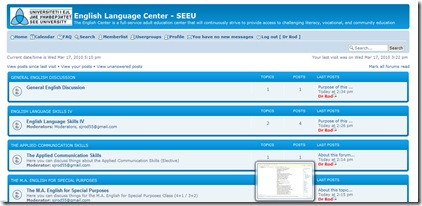
Ardian in Year 2 – Advanced Skills IV class has created the forum listed below for discussion of events in class as well as various other topics. I encourage all my SEE University students to sign on and actively participate – you never know – it might get you extra credit!

http://enforum.justgoo.com/forum.htm

English Forum

Tuesday, March 9, 2010

Importance of Soft skills development in education

Faculty of Teacher Training - English Department

Course Title: Applied Communication Skills (Elective)

Instructor: Dr. Rod

E-mail:  sjrod55@gmail.com

Importance of Soft Skills Development in Education

What are Soft Skills?

“Soft skills” can be said to incorporate all aspects of generic skills that include the cognitive elements associated with non-academic skills. Soft skills are identified to be the most critical skills in the current global job market especially in a fast moved era of technology. The reorientation of education which is one trust of education for sustainability also relates the importance of these so-called soft skills.

Vast research and expert opinions have been sought in the effort to determine the specific soft skills to be implemented and used in higher institutions of learning.  Based on the research findings obtained, seven soft skills have been identified and chosen to be implemented in all institutions of higher learning here. They are:

i. Communicative skills.

ii. Thinking skills and Problem solving skills.

iii. Team work force

iv.. Life-long learning and Information Management

v. Entrepreneur skill

vi.. Ethics, moral and professionalism

vii. Leadership skills

Each of the above soft skills comprised of several sub-skills. These sub-skills are divided into two categories of implementation. The first category delineates the soft skills that every individual must have and the second category represents soft skills that are good to have. Despite the emphasis being put on the soft skills that must be present (must have), it is also encouraged to inculcate the soft skills that are good to have. All elements of soft skills must be acquired by each individual student and evaluated effectively and comprehensively. Table 1 shows the seven soft skills and the two categories of sub-skills respectively.

The must have soft skills must be acquired by each and every individual in the institutions of higher learning without which, the student is regarded as incompetent in the above skill. The good to have soft skills can be regarded as the additional generic skills and a bonus to the student. If these skills are acquired by the students together with the must have soft skills. Table 1 gives a detail description of the different categories of implementation for each of the sub-skills for the respective seven soft skills.

It can be observed that education is an essential tool for achieving sustainability. We all realized that the current economic development trends are not sustainable and that ….

Table 1           the Must Have and Good To Have Elements of Soft Skills

No.

Soft Skills

Must Have Elements (Sub-Skills)

Good To Have Elements (Sub-Skills)

1.

Communicative Skills

Ability to deliver idea clearly, effectively and with confidence either orally or in writing

Ability to practice active listening skill and respond.

Ability to present clearly and confidently to the audience.

Ability to use technology during presentation.

Ability to discuss and arrive at a consensus.

Ability to communicate with individual from a different cultural background.

Ability to expand one’s own communicative skill.

Ability to use non-oral skills.

2.

Critical Thinking and Problem Solving Skills

Ability to identify and analyze problems in difficult situation and make justifiable evaluation.

Ability to expand and improve thinking skills such as explanation, analysis and evaluate discussion.

Ability to find ideas and look for alternative solutions.

Ability to think beyond..

Ability to make conclusion based on valid proof.

Ability to withstand and give full responsibility.

Ability to understand and accommodate oneself to the varied working environment.

3.

Team Work

Ability to build a good rapport , interact and work effectively with others.

Ability to understand and play the role of a leader and follower alternatively.

Ability to recognize and respect other’s attitude, behavior and beliefs.

Ability to give contribution to the planning and coordinate group work.

Responsible towards group decision.

4.

Life-Long Learning & Information Management Skill

Ability to find and manage relevant information from various sources.

Ability to receive new ideas performs autonomy learning.

Ability to develop an inquiry mind and seek knowledge.

5.

Entrepreneurship skill

Ability to identify job opportunities.

Ability to propose business opportunity.

Ability to build, explore and seek business opportunities and job.

Ability to be self-employed.

6.

Ethics, Moral & Professional

Ability to understand the economy crisis, environment and social cultural aspects professionally.

Ability to analyze make problem solving decisions related to ethics.

Ability to practice ethical attitudes besides having the responsibility towards society.

7.

Leadership skill

Knowledge of the basic theories of leadership.

Ability to lead a project.

Ability to understand and take turns as a leader and follower alternatively.

Ability to supervise members of a group.

….public awareness, education and training are the key elements to move our society towards sustainability. Only a quality future human capital can envision development of its nation to meet the needs of the present without compromising the ability of future generations to meet their own needs. Therefore, the inculcation of soft skills among the students will be two prongs, to produce quality human capital and to develop their knowledge, understanding, values and skills as well. How the two skills blend together will be discussed here.

(1)        Communicative Skills

The communicative skills involve effective communication in both the national language and English language in different contexts and with different people. There are eight sub-skills under communicative skills of which three are the must have skills and five are the good to have skills. Communicative skills are an integral part of any education system either in higher education or lower education. As mentioned earlier, in many countries, basic education or primary education is mandatory and it focuses on reading, writing and ciphering. People learn to read books, write letters, figure accounts and develop skills necessary to fulfil their expected roles in their households and community. At this very level, emphasis has been given to develop the communicative skills of individual so that by the time they leave college, they are able to participate in public and community activities and decision making. What is found to be missing in the nation’s present human capital is the lack of communicative skills. The absence of good communicative skills somehow or rather has an influence on the poor presentation of their views and decisions made to gain others confidence and respect. Communicative skills have also been greatly emphasized in the reorientation of basic education for ESD (Education for Sustainable development) which is: the ability to communicate effectively (both orally and in writing). The communicative skill seemed to be one important component that lacks in the future human capital. The incompetence of the future graduates to master both languages will be a set-back to a lot of potential development and advancement of the country. Thus, this is a good time to reorientate the curriculum of higher institutions to embed communicative skills.

2.         Critical Thinking and Problem Solving Skills

This skill includes the ability to think critically, creatively, innovatively and analytically. It also involves the ability to apply knowledge and understanding to new and different problems as well. For ESD to be successful, it must give people practical skills that will enable them to continue learning after they leave school, to have a sustainable livelihood and to live sustainable lives. The critical thinking skills, skills to organize and interpret data and information, skills to formulate questions and the ability to analyze issues that confront communities are greatly addressed in the reorientation of basic education in ESD. The following are some examples of skills that comply with ESD and some of these skills are similar to the soft skills being emphasized in the curriculum of higher education. The ability to think about systems (both natural and social sciences).

(i) The ability to think in time-to forecast, to think ahead, and to plan.

(ii) The ability to think critically about value issues.

(iii) The ability to separate number, quantity, quality and values.

All the above skills are important and ‘most’ students will require them as the grow into adults.

(iii)       The Skill of Team Work

The ability to work with people from different social and cultural backgrounds to achieve a common goal. Students are encouraged to play their role in the group and to respect opinions and attitudes of others in the group. They are also expected to contribute to the group’s plan and coordinate the group’s effort besides being responsible to the group’s decision. This skill is also part of ESD as stated in the reorientation of basic education: the ability to work cooperatively with other people. If the future human capital can attain these skills, we can be rest assure that the future generation will collaborate ideas and cooperate a taskforce towards the well-being of the nation.

(iv)       Life-Long Learning and Management of Information

This skill involves an effort to learn to be independent or self-regulated learning in acquiring skills and new knowledge. The ability to find and manage relevant information from various sources is also a criterion of this soft skill. Besides this, students are also expected to develop an inquiry mind and crave for knowledge. As mentioned earlier, these characteristics are equally important in ESD in order for an individual to be media literate and consumer knowledgeable. Life-long learning will enable individuals to accumulate as much knowledge and skills over the years.  The ability to manage information well will allow an individual to distinguish between good and bad, to adopt the best practices and to make sound decisions.

(v)        Entrepreneurship skill

The ability to seek business opportunity and develop risk awareness. It also involves being creative and innovative in activities related to business and tasks. To design and plan business propositions and the ability to be self employed.  This skill can in some ways contribute to the society if the training and practice is done for a good purpose.

(vi)       Ethics, Moral and Professional

The ability to practice a high moral standard in professional tasks and social interaction. This skill also includes the ability to analyze ethical problems and make problem solving decisions. Having a sense of responsibility towards society is another criterion of this soft skill.

(vii)      Leadership skill

The ability to lead in various activities and tasks. This is an important criterion in ESD for planning and implementing ideas in a group. This skill is also important to lead in discussion and make decision.

Model for implementing soft skills in higher education

A holistic approach is used to plan and implement the soft skills among students of higher education. This approach is based on the combination of several programs and main activities; formal teaching and learning activities (include all curricular and co-curricular elements); support programs (academic and non-academic focused) and the students? campus life (students? residences and the campus surroundings). Figure 1 shows the framework for implementing soft skills among students of higher institutions. In general, the development of soft skills among the students via the formal teaching and learning activities takes two models: (i) stand alone and (ii) embedded..

(i)         Stand Alone Subject Model

This model uses the approach of training and providing opportunities to students to develop soft skills through specific courses that are carefully planned for this purpose. Usually, these subjects are offered as university courses (such as English language, entrepreneurship, etc) and elective courses (such as public speaking, critical thinking, etc). The courses in this category are often a part of the overall requirements that make up the program. The number of courses and credits in this category depends on the curriculum design and the requirements of the program. The stand alone subject model can also be initiated by encouraging students to sign-up several additional courses which can be accumulated to be a minor course which is different from the initial program signed-up. For example, a student who is pursuing an engineering program is encouraged to take minor courses in management or mass communication. However, such an approach will require an increase in the number of credits and time spent for the particular program.

(ii)        Embedded Model

This model uses the approach of embedding the soft skills in the teaching and learning activities across the curriculum. It does not require the student to take special courses as in the stand alone subject model. Instead the students are trained to master the soft skills through various formal teaching and learning activities that are planned and carried out using specific strategies and methods. In this way, the content and learning outcomes to be achieved for the respective courses are maintained. The learning outcomes related to the soft skills will be integrated and be part of the learning outcomes of the respective courses. This is the suggested model to be implemented in all the courses for the different programs in institutions of higher learning. Each element of soft skills is spelled out in the learning outcomes and then translated into the instructional plan for the semester. This is followed by implementing several teaching and learning activities such as questioning, class discussion, brain storming, team work, presentation, role play and simulation, task/project, field work and site visits.

In general, the development of soft skills using the embedded model requires the expertise of the lecturers to use the various teaching strategies and methods that are entirely student-centered. It also involves active teaching and learning and students should participate actively in the activities. Some of the appropriate strategies and methods that are practical include (i) learning by questioning, (ii) cooperative learning, (iii) problem-based learning (PBL), (iv) e-learning.

(iii)       Combination of Stand Alone Subject Model and Embedded Model

Each of the respective models described above has its weaknesses and strengths. From the framework, planning, implementing and assessment, the stand alone model is definitely at an advantage. This is because the course or subject is specially developed to assist students to acquire the soft skills. However, this model lacked the opportunity for students to develop and acquire soft skills as integrated with other knowledge and skills in the major discipline studied. The existing number of credits for the respective program is also a constraint for students to sign-up for additional courses on soft skills.

On the contrary, the framework, planning, implementing and assessment of the embedded model are more challenging than the stand alone model. This model requires the lecturers to master specific teaching and learning skills and then apply these skills in teaching the respective core courses for the specific program. However, when carefully planned and used the appropriate teaching and learning strategies, this model is more effective in developing and acquiring the soft skills as integration with the other knowledge and skills in the program. In addition, this model does not require any additional courses to the already existing courses of the respective program.

Based on the weaknesses and strengths discussed, the higher education institutes are encouraged to use the embedded model as compared to the stand alone model. This is because the embedded model focus on student centered learning such experiential learning, problem-based learning and gives students the practical experience as well.

Development of soft skills through support programs

This involves programs and activities that are created, developed and used to support soft skills either directly or indirectly. In general, the program and activity can be divided into two: (i) academic support program and (ii) non-academic support program.

The academic support program is to help students acquire the soft skills that are associated with academic matters. Some of these programs include ‘Learning Skills’ and the English Language Support Program (ELSP).

As for the non-academic support program, it assists students to acquire the soft skills that are not related to academic matters but more of personality and professional development of the students. Most of the programs and activities are in the form of co-curriculum and extra co-curriculum.

The development of soft skills through Campus Life Activities.

Most university students spend half of their student life living in residences in the university campus. As such, institutions of higher learning should use this golden opportunity to develop their soft skills. This can be done through carefully crafted programs and carrying them out in the conducive campus grounds.

Conclusion

To live to the challenge of globalization which is in line with the era of information economy, the strength of a nation is strongly dependent on the ability of its citizen to be highly intellectual and skillful. The development of human capital is thus important and necessary since it drives the nation to the envision vision and mission. Without a quality human capital, a nation will be weak as there is no human factor that is capable to embark on new initiatives and perspectives. A quality human capital comes from a quality education process. A carefully designed and well planned education system is critical to developing such human capital. Thus, institution of higher learning plays a very important role to produce a human capital that is highly knowledgeable and skillful to meet the demand and expectations of many people. The teaching and learning processes in institutions of higher learning should be capable to provide such knowledge and skills to future graduates.

Teaching Strategies:

Faculty of Teacher Training

English Department

Course Title: Applied English Skills (Elective)

Instructor: Dr. Rod

E-mail: sjrod55@gmail.com

Teaching Strategies:

As a teacher working with students who are also not native English speakers you are likely to encounter many international students in your career. Their levels of English fluency will vary. Some may have spoken English in school from a young age, while others may be new to the language. English is relatively challenging to learn, and some students will have difficulty with it. I offer the following table as a teaching guide.

Teaching Strategies Chart

EASIER
STRATEGIES

MODERATE
STRATEGIES

ADVANCED
STRATEGIES

CRITERIA

Don’t assume lack of comprehension simply because a student’s spoken English is heavily accented, or assume high levels of comprehension simply because of oral fluency. Get to know the students.

Be aware of the difference between the student who makes a variety of grammatical or lexical errors and the one who makes the same kind of error often.

Point out the most prevalent error pattern and ask the student to concentrate on that pattern when editing.

LECTURE

Highlight key points and articulate them in more than one way.
Write key terms on the board or overhead.
Give students breathing room by illustrating key points anecdotally rather than packing too many ideas and factual support into your presentation.

Provide written handouts for key ideas and instructions.
Vary presentation methods and forms of student-teacher interaction.
Supplement oral presentations with visual material.

Build rhetorical and actual questions into lectures.
Supplement visual with oral information and vice versa.
Supplement exposition with interactive exchange of information.

READING

Check reading comprehension by giving short writing assignments – abstracts, brief summaries, and brief responses to text.
Regularly read student writing and clarify concepts and facts for students who have repeated difficulty.

Help students understand how to use the dictionary strategically for field specific and frequently used academic terms.
Provide study questions or lists of key terms. Ask students to identify terms or concepts they think are unclear.

Have students write about passages of text that don’t make sense or that seem contradictory to them.
Illustrate how word form affects the meaning of key terms and concepts.

DISCUSSION

Periodically review and ask questions about main points.
Be sensitive to the reluctance of students to speak voluntarily.
Acknowledge the difficulty of some concepts.

Have students write and talk in small groups before asking them to articulate answers to interpretive and sophisticated questions in whole-class discussion.

Imagine the ways that students are likely to experience confusion and ask questions that will illustrate the potential for confusion in the material.

PAPERS

Encourage students to share rough drafts with you and focus first on content, not grammatical error or stylistic weakness.

Suggest ways to improve drafts by separating issues of organization and content from issues of language error. Encourage language improvement by noting one or two most pervasive errors at the word or sentence level.

Address key problems with comprehensibility, pointing out the elements that create confusion for you as a reader. Encourage self-editing with a focus on pervasive patterns of error.

STRUCTURE

Encourage students to come to office hours by bringing a sign-up sheet.
When returning an assignment, issue a written invitation to see you.

Allow students to do oral presentations (at least the first one) in groups or pairs, and build in practice time.
Offer review sessions before exams.

Offer a variety of group work opportunities.
Let students select tasks that emphasize their strengths.

ASSESSMENT

When writing questions, express them in simple, clear language, avoiding confusing constructions such as double negatives.
Emphasize the value of authentic work and redrafting or editing.

Assess students’ comprehension early in the quarter and frequently.
Provide instructive comments on written assignments and invite those who are having trouble to make an appointment to see you.

Ask students to submit all drafts of work to you with editors’, tutors’, and your comments visible to assure work is their own.

7 Rules For a Successful Communication Approach With Non-native English Speakers

Faculty of Teacher Training

English Department

Course Title: Applied English Skills (Elective)

Instructor: Dr. Rod

E-mail: sjrod55@gmail.com

7 Rules For a Successful Communication Approach With Non-native English Speakers

Poor communication with non-native speakers may create feelings of alienation, hostility, and resistance due to the ineffective use of English. Those feelings could create an unfavorable working environment.

Here are 7 rules for a successful communication approach when you interact with non-native English speakers:

  1. Never assume that non-native English speakers understand and speak English. Do not presume that they are capable of using English as fluently as native English speakers. Address differences in language and communication difficulties to create a communication-friendly environment.
  2. Show non-native speakers that you are making an effort to speak their language. You do not have to be fluent in the language they speak. Try to learn important words and expressions to make a positive impression. If non-native speakers see that you are trying to speak their language, they will make an effort to speak your language.
  3. Prepare differently. You cannot interact with a non-native speaker the same way you communicate with a native English speaker. Be aware of specific difficulties and prepare ahead of time. Before a conference call, meeting, or presentation, send a prepared written document to the non-native participants. Detail important items and action plans in clear and precise English.
  4. Be creative. During a conference call, meeting, or presentation, it is important to improvise. Creativity is a key element in successful communication with non-native English speakers. Be attentive to their body language and non-verbal communication. Look for signs that they do not understand. If you sense that your message is not clear, be creative and use different words or sentence constructions. Do not hesitate to clarify by asking, "Is that clear?" and "What questions do you have?"
  5. Use a thesaurus. A thesaurus is the most useful tool a native English speaker can use with a non-native speaker. One vital element of effective communication is the ability to systematically use different words if one word is not clear. If there is a word that a non-native speaker has difficulty with, replace it with a synonym.
  6. Keep a journal. Communicating with non-native English speakers is a learning process. It takes time to see which methods and techniques work effectively. If you write down your interactions, you can see the techniques that work and the problems to avoid.
  7. Smile! A smile is universal and communicates more than words. When you are sincere, a smile represents patience, warmth, kindness, and empathy. Those are important qualities you must have when you communicate with non-native English speakers.

Applied Communication Skills (Elective) Course Outline

Faculty of Teacher Training - English Department

Instructor: Dr. Rod

E-mail: sjrod55@gmail.com

Course description: 

Applied Communications Skills is designed to focus on those who are going to be teaching core and additional subjects IN English to NON Native English speakers – i.e. Teachers who use English as a Second Language teaching subjects others than English in English.  The focus of the course will be on identifying the challenges of teaching in this environment as well as the development of strategies that allow you to become an effective and successful teacher or presenter. We will be combining (integrating) the various skills in a flexible, creative manner so that students with varying needs can still meet their own academic, personal and professional objectives.  To this end, the methodological approach will be communicative with pedagogical emphasis on teaching in an ESL environment.

Attendance policy:

In accordance with the university’s attendance policy, students must attend 70% of the meetings in order to be able to pass the course.  If a student misses more than 30 % of the classes, the student will automatically fail the course, regardless of performance on the assignments.  The dismissal of excused absences (medical appointments, family emergencies, etc.) will be taken up on a case by case basis.

Assessment:

Attendance

10 %

Homework

10 %

Interview

10 %

Debate

10 %

Reading skill (reading for gist & reading for details)

10 %

Oral interaction (conversation & argument )

10 %

Listening activities

10 %

Writing assignments

20 %

Quizzes

10 %

Total

100 %

Assessment in this course will be continuous (ongoing).  Students therefore should be advised that each and every meeting is crucial to their success in the course.  The students will be assessed for these components:

Please be well aware that while there will not be formalized mid and final year examinations, the continuous assessments, in total, have the same effect and weigh equally.

Grading Rubric:

Grade Scale

Grade Description

Grade Points

95% - 100%

Excellent

10.0

86% - 94%

Very good

9.0

77% - 85%

Good

8.0

68% - 76%

Satisfactory

7.0

60% - 67%

Passing

6.0

59% - below

Failing

5.0


Incomplete (IN)

0.0

Incomplete (IN): An incomplete grade may be assigned if a student has not finished all course requirements by the end of the semester, but has completed a substantial amount of the work. It is the student’s responsibility to bring pertinent information to the teacher and to reach an agreement on how the remaining course requirements will be satisfied. If requirements are not completed within one year, a failing grade is automatically assigned.

WEEK 1

Introduction to Applied Communication Skills – Overview, present situation and history of ESL teaching within an multi cultural, ethnic classroom

WEEK 2

The philosophy behind multi cultural classrooms and learning environments. What happens when you have 13 mother tongues in one room? How to establish the ground rules.

WEEK 3

Available resources and how to use them. Challenges of those resources and how to identify which resources best meet the needs of your audience

WEEK 4

Developing educational goals and outlines, establishing the expectations of: the student, the teacher/institution and client or parent

WEEK 5

Presentation in groups of 2 on the first 4 weeks work.

Essay on ‘The challenges and advantages of multi lingual, cultural and ethnic teaching situations.

WEEK 6

Adapting available resources for an audience that cannot or does not culturally relate to the materials available vs. using available materials regardless of cultural understanding.

WEEK 7

Designing and adapting your presentation techniques using all available media to get across to your student/audience the main points you are presenting.

WEEK 8

Plan a sample 15 minute lesson on a topic of your choice and present it to a group of 6 students – (Three groups in the class) Rotate the teacher and topic.

WEEK 9

Working with less capable students. Consideration of the home and neighbourhood environment. Family conditions. Accounting for deficits in language acquisition.

WEEK 10

Presentation in groups of 2 on the second 3 weeks work.

Mini project on adapting resources vs. creating resources.

WEEK 11

Design a course unit for a specific group of students (assigned by the professor) – describe the challenges of the course design as well as how you overcame them.

WEEK 12

Review of current educational methodologies and practical examples using videos of teachers/trainers in classroom situations – analysis by class.

WEEK 13

Presentation of 15 minute lessons to and using your fellow classmates.

All of the above is subject to change.